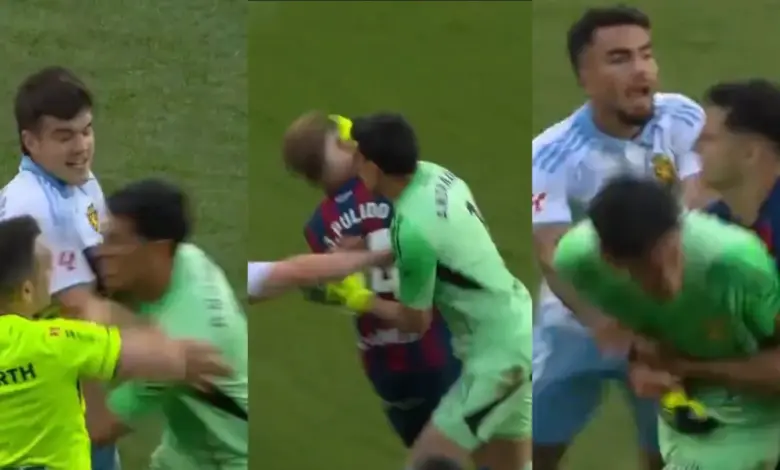
Esteban Andrada turned a tense derby into a disciplinary crisis in the closing moments of the Huesca-Real Zaragoza match. The incident was not just another red card in a heated game; it became the kind of moment that can define a season’s aftermath. With the score already against Zaragoza, the final seconds produced a chain reaction that left multiple players dismissed and the referee’s report at the center of the story. The immediate question now is not what happened, but how far the punishment could go.
What happened in the final minutes
The flashpoint came in stoppage time after Jorge Pulido spoke to Andrada, who was already on a yellow card. The Zaragoza goalkeeper pushed the Huesca captain and was shown a second yellow, leaving the field under pressure and in anger. What followed was the decisive act: Andrada moved toward Pulido and struck him in the face with a punch that triggered a mass confrontation. The match ended with a chaotic scene that also featured other dismissals, including Dani Jiménez and Tasende.
For a derby built on tension and table pressure, the escalation was stark. This was not a routine disciplinary flare-up. It was a violent reaction in a dead-ball moment, which is precisely the type of context that weighs heavily in disciplinary review. The acta, drafted by Dámaso Arcediano Monescillo, is now the key document shaping what comes next for esteban andrada.
Why the acta matters now
The referee’s report is crucial because it frames the incident in specific terms: violent approach, excessive force, and the resulting damage to Pulido. In the wording cited, the punch left the Huesca player with a bruise on the left cheekbone. That detail matters because Spanish disciplinary rules treat aggression differently depending on whether injury is caused. In the context provided, the range described runs from four to twelve matches for aggression without injury, and from six to fifteen when injury leads to time out.
That is why the potential sanction for esteban andrada is being discussed in such severe terms. The report does not leave much room for reinterpretation: it describes a direct, aggressive move after the dismissal, followed by a punch and a collective melee. The same acta also records a punch from Dani Jiménez during the scrum and a kick by Tasende away from the ball, reinforcing how quickly the derby broke apart once control was lost.
Disciplinary risk and club consequences
Beyond the individual punishment, the case carries institutional consequences for Real Zaragoza. A suspension at the upper end of the range would not only remove a starting goalkeeper from selection; it would also close the door on what the context describes as a sad ending to his loan spell. That makes the decision bigger than a single match incident. It becomes a question of squad stability, reputation, and the image of the club in a regional rivalry already framed as one of the darkest endings in the derby’s history.
There is also the issue of timing. The derby was already being played under pressure because of what was at stake near the bottom of the table. When tempers spilled over, the damage was immediate and visible. The possibility of a sanction described in the context as “historic” underscores just how unusual the episode is. For esteban andrada, the outcome could extend well beyond a standard ban and into a rare disciplinary category that few players face.
Expert readings on the wider impact
The key institutional reference here is the disciplinary framework itself, especially the relevant article of the code governing aggression and injury. Its structure shows how a single act can trigger a broad range of penalties depending on severity and effect. The report by Dámaso Arcediano Monescillo, the match official, will be central to the committee’s reading.
What the context makes clear is that the case is being measured not only by the violence of the action but by the fact that it happened after dismissal, in a detached moment when intervention in play was no longer possible. That is often where disciplinary bodies see the greatest intent. In practical terms, the report leaves the committee with a narrow path and a wide sanction band.
Regional fallout and the question ahead
The wider impact reaches beyond one derby. For Huesca and Zaragoza, the ending has already shifted attention from the scoreline to the conduct on the pitch. For the competition, it raises the issue of how severely violent conduct in high-pressure matches should be punished to protect the game’s credibility. And for esteban andrada, the next phase is procedural but consequential: the committee must now decide whether the report’s language translates into a suspension at the top end of the range.
If the final sanction does land near the maximum described in the acta, the derby’s most memorable image may no longer be the score at full time, but the punch that changed everything. How the disciplinary body draws that line will determine whether this becomes a one-off disgrace or a benchmark case for future cases involving esteban andrada.