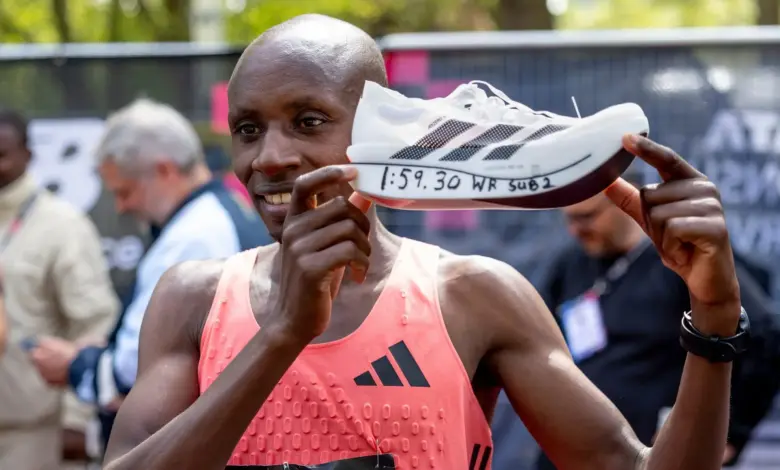
On marathon morning, a shoe that weighs just over 97 grams can feel less like equipment and more like an argument. The adidas pro evo 3 has now moved from a lab-tested concept of extreme lightness into a record-breaking race shoe, but its story is not only about speed. It is also about price, fit, and the gap between elite performance and everyday runners.
What makes the Adidas Pro Evo 3 different?
The adidas pro evo 3 is built around a simple idea taken to an unusual limit: reduce weight without giving up cushioning or energy return. The shoe uses next-generation Lightstrike Pro Evo foam, which the brand says is its lightest and most responsive foam to date. In testing, the updated foam delivered an unmatched weight-to-cushioning ratio, with 153 SA in the heel and 142 SA in the forefoot.
The broader design also reflects that same pursuit. The shoe is described as the first brand effort to truly combine a maxed-out stack height within World Athletics rules, marathon-level shock absorption, and a two-digit weight. Its measured weight places it in that rare category, and the reported running economy improvement of 1. 6% over the previous version adds to the sense that this is a shoe built for the margins that matter in elite racing.
Why does the shoe matter beyond the finish line?
The adidas pro evo 3 matters because it shows how far racing footwear has moved from general running comfort toward specialist performance. One of the clearest trade-offs is fit: lab testing found a restrictive, narrow-feeling toebox that may not suit many runners. The shoe also appears to favor midfoot strikers, while heel strikers may find it less suitable.
That makes the model easier to understand as a tool for a very specific job. It is not positioned as a comfort-first option. It is a race-day instrument, with a design philosophy that puts speed, cushioning, and low mass ahead of relaxed everyday wear. For runners who want a more forgiving super shoe, other models may offer a different balance, but this one is built around extremes.
How did Sebastian Sawe bring the shoe into the spotlight?
The shoe’s most visible moment came when Sebastian Sawe wore it to run sub-2 at the 2026 London Marathon. That performance turned the adidas pro evo 3 into more than a product launch. It became a symbol of how racing technology, elite preparation, and a single day’s effort can intersect.
Stephan Scholten, adidas’ vice president of product, said, “Our goal was two digits on the scale, with better performance than we’ve ever had. ” Charlotte Heidmann, Adidas category director for Adizero, said, “When you think you’ve reached the limit, you actually haven’t. There’s always more you can achieve. ”
Those remarks frame the shoe as the result of three years of research and a deliberate push toward what seemed out of reach. The upper was inspired by kitesurfing sails, and the carbon structure was redesigned into a new form that rethinks stiffness and propulsion.
What are the limits of a shoe like this?
There is a sharp practical limit built into the adidas pro evo 3 from the start: cost. The shoe is extremely expensive, with a price that makes it difficult to justify for amateurs. The review context also notes that it sits in a market where other super shoes can deliver light builds and high speed for less money.
Its narrow fit is another limit, and its very soft ride may not appeal to runners who prefer something firmer and more predictable underfoot. In other words, the shoe’s strengths are real, but so are its boundaries. It is engineered for a narrow lane of use, both literally and figuratively.
What does the adidas pro evo 3 say about running’s future?
The adidas pro evo 3 shows how performance design can keep pushing toward lighter weight, greater bounce, and stronger race-day efficiency. It also shows that the most advanced shoes are still shaped by compromise. A shoe can be record-breaking and still be too expensive for most runners, too narrow for many feet, and too specialized for general use.
At the London Marathon, that tension was hidden inside a fast stride and a historic result. But after the finish line, it remains visible in the shoe itself: a piece of engineering that promises more than ever, while reminding runners that the highest level of speed rarely comes without a cost.
Image caption: adidas pro evo 3 on race day, where extreme lightness meets elite marathon ambition.