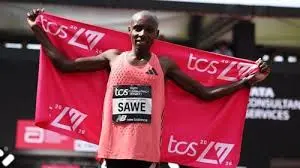
On the Mall in London, sabastian sawe crossed the line into a moment that felt both precise and unreal. The clock showed 1 hour, 59 minutes and 30 seconds. In a race built on endurance, the 30-year-old Kenyan had become the first athlete to break the two-hour barrier in an official marathon.
What happened on the streets of London?
The men’s race moved at a pace that quickly began to redraw what seemed possible. Sawe led the field home in 1: 59: 30, 65 seconds faster than the previous best set by Kelvin Kiptum in 2023. Ethiopia’s Yomif Kejelcha finished 11 seconds behind him in his debut marathon, while Uganda’s Jacob Kiplimo took third in 2: 00: 28.
The conditions helped make the day fast. The start was sunny, the temperature was 11 degrees Celsius, and a gentle tailwind followed the runners over the decisive final miles. Early on, six men, including Sawe and Kiplimo, were in contention and passed 10km in 28: 25, just under world-record pace. At halfway, they were through in 60: 29, only 12 seconds down. For much of the race, the outcome still looked open.
Why did Sabastian Sawe change the race so suddenly?
For a long stretch, the men’s contest looked fast but not historic. Then, after the last pacemaker dropped out, Sawe and Kejelcha surged away at a drinks station, catching Kiplimo out. From that point, the pressure sharpened. Between 30km and 35km, they covered 5km in 13: 54, a tempo that left little room for recovery.
Near the end, Sawe had the fresher kick. On Birdcage Walk, he made the decisive surge that broke Kejelcha and sealed the record. His second half, finished in 59: 01, underlined how unusually strong the closing stages were. His overall time was also 10 seconds faster than Eliud Kipchoge’s unofficial marathon effort in Vienna in 2019.
What does the record mean beyond one finish line?
Sawe’s run was not only a personal triumph; it was a public shock to the sport’s limits. The headline number changed the frame for what an official marathon can be. The race also showed how small advantages — weather, pacing, timing, and preparation — can combine into a result that once seemed out of reach.
Sawe himself framed the day in personal terms. “I am feeling good, I am so happy, ” he said. “It is a day to remember. ” He added that coming to London for the second time mattered to his preparation, and that the work he had done for four months had finally paid off. He also pointed to the crowd: “If it was not for them, you do not feel you are so loved. You feel so happy and strong. ”
Who was in the background of the breakthrough?
Sawe’s team had said he was in shape and would benefit from Adidas Adios Pro 3 supershoes, which weigh 97 grams and were said to retail for about £450. That detail sits beside the larger reality of elite racing: performance now depends on training, conditions, and equipment as much as on raw talent. In the same race, Ethiopia’s Tigist Assefa defended her women’s title, adding another high-level performance to a day already defined by speed.
Still, the result may invite scrutiny because Kenyan runners have faced doping questions in recent years. The race itself, however, is clear in what it produced: an official marathon finish under two hours. sabastian sawe did not just win in London. He transformed a barrier into a fact, and left the finish line carrying a question that now belongs to the rest of the sport: what comes after a milestone that once seemed impossible?
Image alt text: sabastian sawe crosses the finish line in London after breaking the two-hour barrier in the marathon