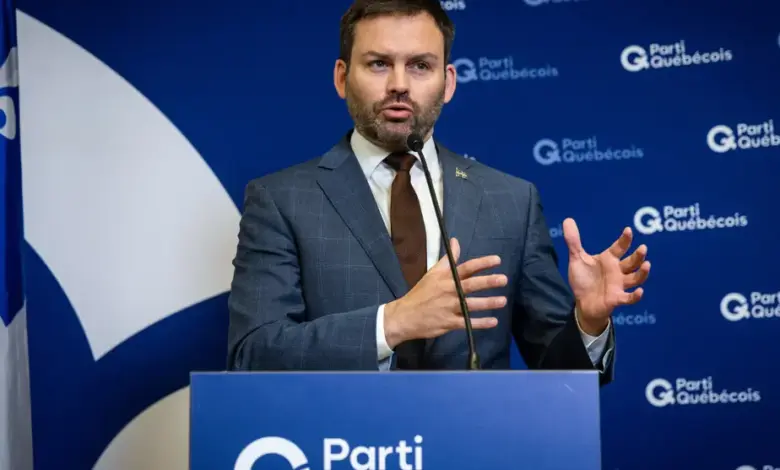
Référendum is now doing more than testing party loyalty in Quebec; it is shaping the strategic ceiling for the Parti québécois and forcing rivals to define themselves around the same fault line. Paul St-Pierre Plamondon says he will hold one in a first mandate no matter what the polls say, and that stance is now colliding with a new Léger survey that suggests a larger opening if he changed course.
What Happens When a Promise Becomes the Test?
The timing matters because the latest numbers do not simply measure support for one party. They measure the cost of consistency. The PQ is at 31 percent, the Liberals at 28 percent, and the CAQ at 17 percent with Christine Fréchette. At the same time, the PQ would reach 39 percent if it set aside the promise of a référendum in a first mandate. That gap is the current political fault line: a stronger path to power versus a pledge that remains central to the party’s identity.
St-Pierre Plamondon has rejected the idea that a poll should rewrite a political commitment. He has argued that changing position after seeing a survey would undermine trust in political promises. He has also said the referendum is not for tomorrow morning, stressing that the broader context remains uncertain and that a four-year window leaves room for events to evolve.
What Happens When the Poll Numbers Are Read as a Map?
The broader landscape is still fluid, and the clearest institutional signals come from the Léger survey itself and the party reactions it triggered. One useful way to read the numbers is by looking at the trade-offs:
| Signal | What it suggests |
|---|---|
| PQ at 31 percent | The party remains competitive while keeping its current line |
| PQ at 39 percent without a référendum commitment | The promise carries a measurable electoral cost |
| Sovereignty at 35 percent | Support is rising, but still below a majority threshold |
| CAQ at 17 percent with Christine Fréchette | The governing right-of-center space is changing shape |
| Liberals at 28 percent | The federalist field remains highly competitive |
That picture is reinforced by the shifting social patterns in the same survey. Men show stronger support for independence than women, and women are more favorable to the PQ if the party drops the référendum promise. Younger Quebecers show more openness to sovereignty than older voters, but that does not translate automatically into support for the PQ. The message is clear: the sovereignty question still organizes opinion, but not all of the party’s potential support is willing to follow it at the same speed.
What If the Battle Is No Longer PQ Versus Everyone?
The fight is increasingly becoming a contest among federalist options as well. Christine Fréchette’s rise matters because it complicates the Liberal calculation. With two leaders drawn from business-oriented backgrounds and both positioned as federalists with an economic focus, the overlap is obvious. The result could be a kind of vote transfer between the CAQ and the PLQ, especially if Fréchette is able to embody change more convincingly.
That dynamic matters because the PQ is not simply deciding whether to keep or abandon a promise; it is also watching how the rest of the field adjusts around it. The Liberals may try to avoid direct competition on identity and autonomy, while the CAQ must prove that it can still speak to nationalist voters without losing its center of gravity. In that context, the référendum remains both an obstacle and a differentiator.
What Happens When the Field Splits Three Ways?
Three futures now look plausible. In the best case for the PQ, it keeps its referendum line, sustains sovereignty support, and turns consistency into a governing advantage. In the most likely case, the party stays near the front but continues to face the same ceiling created by the pledge, making majority arithmetic difficult. In the most challenging case, the promise remains popular with the base but keeps enough voters at distance to prevent the party from converting momentum into a clear mandate.
For rivals, the implications are equally sharp. The Liberals need to decide whether they can win by emphasizing moderation and economic credibility alone. The CAQ needs to prove that Fréchette’s momentum is durable, not just a short-term bump. And voters who are uneasy with a référendum will continue to shape the outcome even if they are not all moving in the same direction.
What Should Readers Watch Next?
The most important thing to understand is that the référendum debate is no longer only about independence itself. It is now a test of leadership credibility, voter segmentation, and the limits of political flexibility. The next phase will hinge on whether support for sovereignty keeps rising, whether the PQ can hold its current position without softening its promise, and whether the CAQ and Liberals can turn the federalist field into a real alternative.
For now, the signal is not that one side has settled the issue. It is that the issue still has the power to reshape the race, the coalition math, and the meaning of a mandate. That is why the next move will matter so much for référendum.