lisa raitt has returned to the center of Canada-U. S. trade politics, this time on a revived advisory council built to help Prime Minister Mark Carney navigate a tense moment ahead of USMCA talks. The appointment matters not because it changes policy overnight, but because it shows Carney is widening his circle at a time when trade strategy is being tested in public. With Lisa Raitt and other former Conservative figures included, the panel signals an attempt to blend experience, credibility, and political reach.
A cross-partisan council for a high-stakes trade review
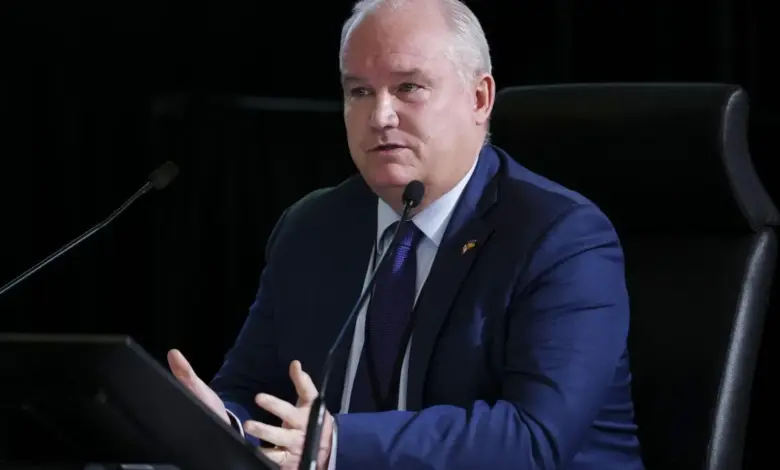
Carney announced Tuesday that the revived advisory committee on Canada-U. S. economic relations will serve as “a forum for expertise and strategy on all aspects of the Canada-U. S. economic relationship. ” The move comes as discussions around the Canada-U. S. -Mexico trade deal move closer to a decisive phase. In that setting, Lisa Raitt is one of the most notable names on the list, alongside former Conservative leader Erin O’Toole.
The political meaning is hard to miss. Carney is reaching beyond Liberal ranks and into Conservative circles at a time when the opposition is pressing him to show a clearer plan. That choice may be designed to strengthen the government’s negotiating posture, but it also acknowledges that the trade file is too consequential to be handled as a purely partisan exercise. The presence of Lisa Raitt gives the council an industry-facing, political, and institutional profile that could prove useful as pressure builds.
Why Lisa Raitt matters in this advisory mix
Lisa Raitt is identified as a CIBC executive and a former Conservative cabinet minister and deputy leader. That combination gives her a profile that bridges business and politics, which is precisely what a Canada-U. S. advisory body appears intended to leverage. The council itself is chaired by Canada-U. S. Trade Minister Dominic LeBlanc, not the prime minister, reinforcing that it is meant to inform strategy rather than replace formal negotiations.
This design matters because the current debate is not just about whether Canada should engage Washington, but how it should frame its own leverage. Carney’s recent argument that Canada’s close trade ties with the U. S. have become a source of “weakness” has already sparked criticism from Conservatives. The inclusion of Lisa Raitt suggests the government wants a broader range of voices as it prepares for a review that could reshape the rules governing the relationship.
The pressure building around USMCA talks
The timing of the council’s revival is the real story beneath the personnel list. U. S. Commerce Secretary Howard Lutnick recently called the current North American trade agreement a “bad deal” for Americans and suggested it may be allowed to “lapse” this summer. United States Trade Representative Jamieson Greer said earlier this month that he does not expect negotiations to be resolved by July 1.
Those comments sharpen the stakes for Canada, where uncertainty around the future of the deal has already become part of the political conversation. In that context, the revived council looks less like a symbolic gesture and more like an early-warning mechanism. The fact that Carney turned to Lisa Raitt while also bringing in Erin O’Toole points to a deliberate effort to present a more unified national front, even as partisan conflict continues outside the room.
Political signals and regional implications
The broader implication is that Ottawa appears to be preparing for a difficult round of talks without assuming the old relationship can simply be carried forward. Carney said Canada cannot “bet our future in the hope that it will suddenly stop, ” referring to disruption from the United States. That language suggests a reassessment underway, not only of trade tactics but of the assumptions that have long underpinned Canada’s economic planning.
For Canada’s provinces and industries, especially those exposed to the trade relationship, the stakes are immediate. A council with Lisa Raitt on it may help the federal government test ideas, but it also highlights how much depends on the tone and structure of the coming negotiations. If the United States moves toward a harder line, Canada will need both political cohesion and technical strategy to respond.
What the revived council may reveal next
For now, the most important takeaway is that Carney is betting on expertise with political range. Lisa Raitt’s role on the council is significant not because it settles the trade debate, but because it marks an effort to broaden the conversation before the pressure peaks. The real question is whether that approach can produce a clearer national strategy before the next phase of USMCA negotiations forces the issue.