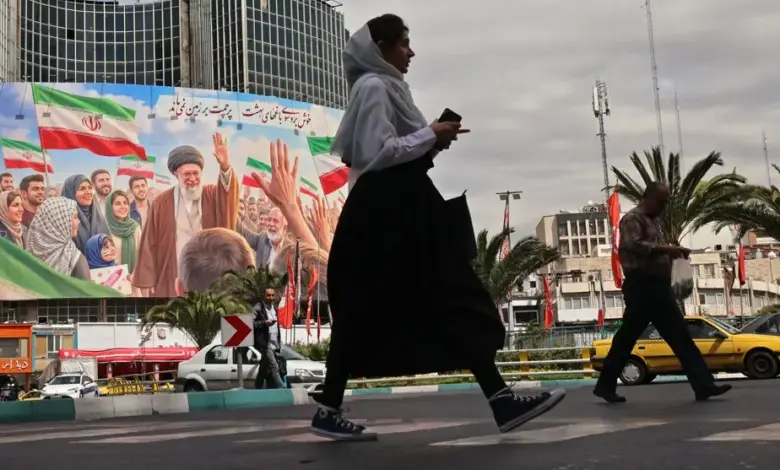
In Tehran, a panel showing the assassinated Iranian supreme leader stands above passersby on Valiasr Square, a reminder that négociation now unfolds under the shadow of grief, force, and uncertainty. As a U. S. delegation prepares to arrive in Pakistan, Iran says it has no current plan to take part in the next round of talks.
Why are the talks still uncertain?
Iran’s state television said Tehran has no plan to participate in the next session of Iran–United States discussions. The official IRNA agency went further, saying there is no clear prospect of successful négociation. The message leaves the next diplomatic step unresolved just as the ceasefire deadline approaches.
The timing matters. A U. S. delegation is expected in Pakistan on Monday evening ET to try to revive peace talks. The setting has already been tightened by security measures in Islamabad, where roads have been closed and barricades placed near the Serena Hotel in the red zone. The scene reflects a process that is not moving forward with confidence, but with caution.
What is pushing the dispute beyond the table?
Diplomacy is being strained by events at sea. Iranian media say a naval blockade imposed by the United States would need to be lifted before any talks could move ahead. That condition, whether formal or not, shows how closely négociation is tied to the wider conflict beyond the conference room.
The tensions sharpened after the U. S. Navy seized the Iranian cargo ship Touska in the Gulf of Oman. Donald Trump said on his platform Truth Social that the ship tried to cross a maritime blockade. Iran’s military leadership responded that it would retaliate soon, calling the seizure an act of armed piracy. The same day, oil prices surged, with West Texas Intermediate jumping by more than 8% in early Asian trading.
How are people in Tehran absorbing the stalemate?
Even as airports reopened in Tehran for the first time in weeks, daily life is trying to continue. Cafés are busy, parks are full, and people are back on the streets. But the mood remains heavy. A 30-year-old biologist who did not give her name said the losers are the Iranian people. Saghar, 39, described a country marked by deaths in strikes, economic hardship, arrests, and executions, saying she no longer had the energy to speak.
That human exhaustion is part of the broader picture. The ceasefire has not ended the fear that the conflict could widen again, and the uncertainty around négociation is feeding that anxiety.
What do officials on both sides say now?
Iranian foreign ministry spokesman Esmaïl Baghaï said there is no plan at this stage for the next cycle of talks and no decision has been made. He questioned whether the United States is serious about the diplomatic process. That skepticism is reinforced by the renewed confrontation over the Gulf of Oman, the maritime blockade, and what Iran calls violations of the ceasefire.
On the American side, Donald Trump said the United States is offering Iran a “reasonable deal, ” while warning of severe destruction if it refuses. He also said the truce is unlikely to be extended. Those statements keep pressure on the process even as both sides remain locked in public confrontation.
For now, the most visible reality is hesitation. Négociation exists, but only as a possibility suspended between a deadline, a naval seizure, and a city waiting behind barricades. In Tehran, the man on the billboard looks over a capital that has reopened, but not relaxed; the next move is still missing.