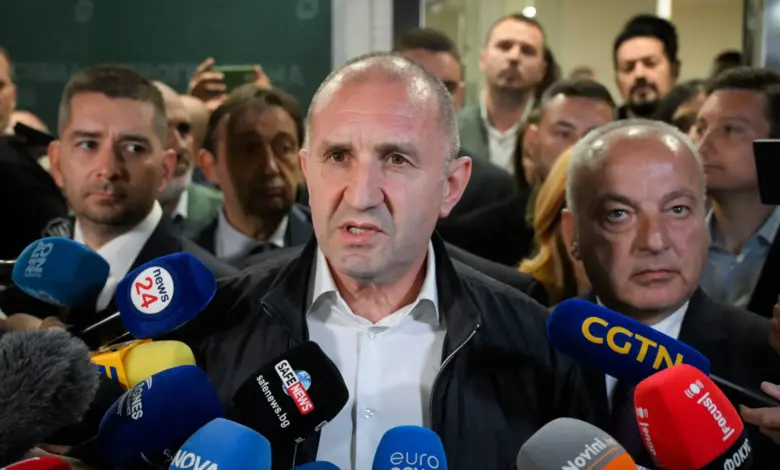
On a cold Sunday in Sofia, the vote felt less like a routine political exercise than another test of endurance. Rumen Radev, Bulgaria’s former president, emerged as the face of a new lead in parliamentary projections, while voters and party leaders alike confronted the same question that has shadowed the country for years: who can actually govern?
Why did this vote matter so much?
This was Bulgaria’s eighth parliamentary election in five years, a pattern that has turned elections into repeated attempts at repair. Projections put Radev’s Progressive Bulgaria grouping at 44%, far ahead of Boyko Borissov’s GERB party and the PP-DB coalition, both near 12%. If that projection holds, it would give Progressive Bulgaria an absolute majority of at least 129 seats in the 240-seat parliament.
Radev called the result a “victory of hope” and said his group had won “unequivocally. ” He framed the outcome as a break from distrust and fear, but he also acknowledged the harder task ahead: turning a lead into a government that can last. That caution matters in Bulgaria, where successive governments have come and gone since 2021.
What is driving voters back to the ballot box?
The repeated elections reflect a deeper public frustration with corruption, weak institutions, and unstable coalitions. Bulgaria has seen anti-graft rallies repeatedly shake the political order, including protests that helped bring down the conservative administration of pro-European leader Boyko Borissov and later the latest conservative-backed government.
One retired engineer, Stiliana Andonova, described the mood plainly after voting in Sofia: “Everything simply has to change. ” She named the judicial system and corruption as her main concerns. Her words echoed the broader sense that the ballot has become a referendum on whether the state can function more cleanly and predictably.
Radev has built his appeal around that frustration. He has promised to fight corruption and to rid the country of what he calls an “oligarchic governance model. ” At the same time, he has presented himself as a leader who can steer Bulgaria through another reset without severing its European direction.
Can Progressive Bulgaria turn a lead into a stable government?
That is the central uncertainty. Radev said Bulgaria would “make every effort to continue on its European path, ” while also arguing that a strong Bulgaria and a strong Europe need “critical thinking and pragmatism. ” He added that he hoped for “practical relations with Russia, based on mutual respect and equal treatment. ”
His position puts him in a complicated place. He has called for renewing ties with Russia and has opposed military aid to Ukraine, while also saying he would not use Bulgaria’s veto to block European Union decisions. He has denounced a 10-year defense agreement between Bulgaria and Ukraine. Those views place him at odds with Bulgaria’s more openly pro-European and pro-Ukraine voices, including Borissov, who said that “winning elections is one thing, governing is another. ”
Boryana Dimitrova of the Alpha Research polling agency called Radev an “unequivocal winner. ” But the exit from one political crisis does not guarantee entry into the next phase of stability. Radev said he was ready to consider different options so that Bulgaria could have a “regular and stable government, ” and he noted that a minority government was also an option.
What happens next after the vote?
Official final results were expected no earlier than Monday, while Andrey Gurov was set to head a caretaker government tasked with organizing snap elections. That arrangement underlines how fragile the current moment remains, even after the projection that put Progressive Bulgaria in front.
Still, the election also showed that many Bulgarians are not simply rejecting politics; they are demanding more from it. Bulgaria, now part of the European Union and using the euro, is still searching for a governing formula that can match public impatience with institutional repair. Until that happens, each vote may feel like both a verdict and a plea for normal life.
Image alt text: Vote in Bulgaria as Rumen Radev’s Progressive Bulgaria leads projections after a tense parliamentary election in Sofia.