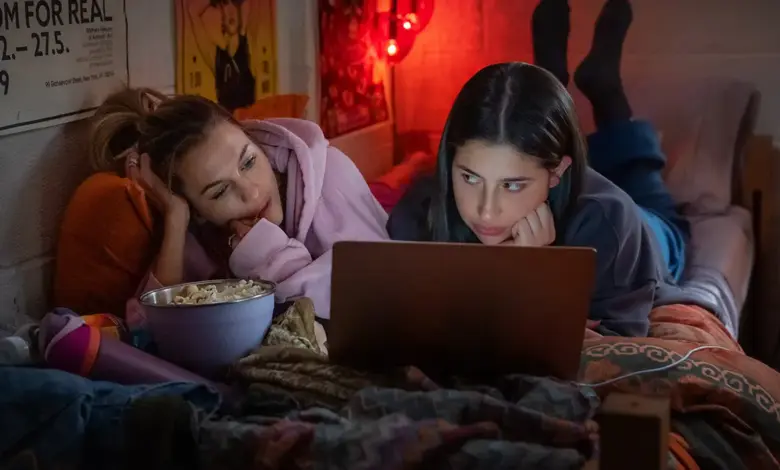
adam sandler’s latest Netflix-linked comedy, Roommates, arrives less like a broad joke machine and more like a careful study of how fast a friendship can fray. Set inside the pressure cooker of freshman year, the film turns a college room into a place where insecurity, status, and small betrayals gather force.
What makes Roommates feel different?
For years, the most visible part of Adam Sandler’s Netflix relationship was built on noisy, empty comedies that left little behind once the credits rolled. But the newer pattern around his production company, Happy Madison, has shifted toward stories with more warmth and more emotional texture. That shift matters here because Roommates places its conflict inside something recognizably human: two young women who begin as friends and slowly become enemies.
The film follows Devon, played by Sadie Sandler, and Celeste, played by Chloe East, as roommates whose connection unravels during their freshman year. The setup is simple, but the detail is in the small wounds: a Venmo request left hanging, an Instastory that feels shady, a poem that may have revealed too much, and an uneasy edge around family wealth. These are not the loud jokes of a slapstick farce. They are the kind of social misfires that can shift a room’s atmosphere without anyone naming the change out loud.
The result is a comedy that treats college life as a place where identity is performed and tested at the same time. Devon is written as someone who has not exactly been a social outcast, but has also never found her people. Celeste has the effortless appeal that draws attention without effort. Their clash gives the movie its shape, and the strain between them becomes the point.
How does the film connect to a wider pattern in Adam Sandler’s work?
adam sandler’s production choices have increasingly leaned into projects that balance comedy with emotional clarity. In this film, that direction shows up in the way the story avoids exaggeration when quieter behavior can do the job better. The college dean, played by Sarah Sherman, frames the story with a structure that echoes a tale of domestic collapse, while a subplot involving Devon’s closeted gay brother, played by newcomer Aidan Langford, adds another layer of feeling without pushing the film away from its core friendship story.
That approach reflects a broader shift in the kind of projects Happy Madison has supported. The company’s better recent work has found success by going sweet without flattening the story into easy sentiment. In Roommates, that means the comedy still lands, but it lands through specificity. The tension comes from recognition, not spectacle.
Chandler Levack directs the film, and the script comes from SNL writers Jimmy Fowlie and Ceara O’Sullivan. Their work keeps the conflict grounded in the messy logic of college social life, where a single slight can echo longer than either person expects. The film is imperfect, but its attention to emotional mechanics gives it a stronger pulse than the average streaming comedy.
Why does the soundtrack matter so much here?
The movie’s soundscape helps explain why it feels so tied to a particular moment in young adulthood. The soundtrack moves through nostalgic 90s references, 2000s indie-sleaze energy, and modern alt-pop, with tracks from Charli XCX, Olivia Rodrigo, The Killers, and Mac Miller. That mix does more than decorate scenes. It mirrors the shifting tone of a friendship that cannot decide whether it is playful, performative, or already in decline.
The original score, composed and performed by Ryan Holladay and Hays Holladay, also known as The Holladay Brothers, reinforces that unstable mood. Their music supports the movement between Devon and Celeste, shaping the emotional turns without overwhelming them. For a story built on passive aggression and unspoken tension, the score becomes part of the argument.
This matters because the film is not only about two roommates at odds. It is also about how culture packages youth: in music cues, in social cues, in the distance between how people present themselves and what they actually need. That is where Roommates finds its sharper edge.
What does Roommates suggest about the future of Adam Sandler’s Netflix era?
adam sandler’s role here is less about starring in the film and more about helping sustain a model that gives younger storytellers room to build character-led comedies. Roommates suggests that the most durable version of that model may be one that trusts emotional friction more than punch lines alone. It also suggests that family participation does not automatically flatten a movie when the writing gives those relationships real texture.
For viewers, the appeal may be in how familiar the emotional geography feels. A dorm room can become a battlefield without anyone raising their voice. A friendship can collapse through a dozen tiny cuts. And a comedy can still be funny while letting the sadness show through. By the time the story circles back to Devon and Celeste, the room no longer feels like a simple backdrop. It feels like the place where a bond changed shape and could not be repaired the same way twice.