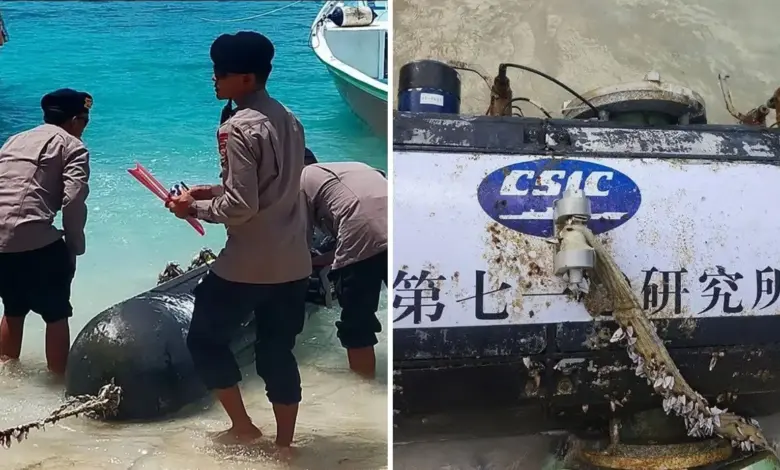
A torpedo-like object found off Lombok has turned the lombok strait into a legal stress test: if it is not a ship, then the familiar rules of passage may not apply at all. That is the central tension now facing Indonesia after fishers discovered the object north of Gili Trawangan on 6 April.
What exactly was found in the lombok strait?
Verified fact: Indonesian fishers found a torpedo-like object in waters north of Gili Trawangan, Lombok. The exact coordinates are unknown, as is the object’s direction of travel. Much else remains uncertain, including whether it was moving within Indonesia’s archipelagic sea lane ALKI II in the lombok strait or outside it, what activity it was conducting, and whether it can be linked to a state.
Verified fact: Speculation continues that the object may be an unmanned underwater drone linked to a Chinese company. The investigation continues. The available description is enough to raise one difficult question: does the object count as a “ship” under international law, or does it fall outside that category entirely?
Why does the ship question matter so much?
Verified fact: Under international law, ships enjoy the right of innocent passage through Indonesian territorial and archipelagic waters, and the right of archipelagic sea lanes passage through routes normally used for international navigation in Indonesian archipelagic waters and the adjacent territorial sea, whether designated or not.
Verified fact: Those rights belong only to a ship. The problem is that the United Nations Convention on the Law of the Sea never defines “ship. ” Its rules, however, reveal what its drafters assumed: a vessel should navigate on the surface, fly a flag, observe international collision regulations, comply with coastal state laws, and follow designated sea lanes and traffic separation schemes. Those assumptions point to something visible, identifiable, and capable of communicating with external parties.
Informed analysis: The object found off Lombok appears to strain that framework. If it cannot surface on command, identify itself, or respond to Indonesian authorities, then the legal system may be confronting a craft it was never built to classify cleanly. That uncertainty is not abstract. It determines whether Indonesia can treat the object like a protected vessel or as something it may intercept and confiscate.
Does the evidence suggest research or survey activity?
Verified fact: The object likely fails every test associated with ordinary passage. There is no visible flag. There is no indication it can surface on command, identify itself, follow passage rules, or respond to Indonesian authorities.
Verified fact: Media descriptions say it bears Chinese characters meaning “research and development” and the logo “CSIC, ” associated with China Shipbuilding Industry Corporation. Police described it as bearing characteristics commonly found in underwater observation or survey equipment. It was reportedly fitted with underwater sensors, sonar, and oceanographic cables, and found to contain an acoustic Doppler current profiler.
Informed analysis: Those details matter because passage loses its innocent character if a vessel conducts research or survey, or anything else not having a direct bearing on passage. The same prohibition applies to archipelagic sea lanes passage. If the object was transiting through the lombok strait as part of ALKI II, research or survey activity would not be allowed without Indonesia’s prior authorisation.
What can Indonesia legally do now?
Verified fact: If the object is not a ship, Indonesia may intercept and confiscate it. That would, however, place Indonesia at odds with major powers that recognise unmanned underwater vehicles as ships.
Verified fact: If it is a ship but was carrying out research or survey activity, the legal position changes again: such activity is not protected by innocent passage or archipelagic sea lanes passage. The decisive questions are whether the object qualifies as a ship and whether its conduct remained within the limits of passage.
Informed analysis: That is why the case matters beyond one discovery. The real threat for Indonesia may be a class of small, undetectable drones quietly collecting data across Indonesian waters with no flag, no crew, and no one to call. The object found off Lombok has made that problem visible.
Accountability question: Public clarity now depends on whether the investigation can establish the object’s status, purpose, and route. Without that, the legal ambiguity in the lombok strait remains unresolved, and Indonesia is left to decide whether an unmanned underwater object should be treated as a protected ship, a survey platform, or something that falls entirely outside the rights it would otherwise claim.