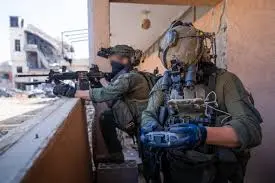
In the dark stretch of sea off Naqoura, Lebanon, a small force moved in from the water and crossed a line that had not been crossed in the same way since 2000. The israeli navy says that operation, carried out by Shayetet 13, was part of a broader shift in how Israel has fought since the October 7 massacre: less static defense, more forward-leaning action, and far more secrecy.
What the navy has now described is not a single raid, but a wider pattern of cooperation with intelligence agencies and special forces. It is a pattern that reaches from Lebanon to Gaza and, in some cases, to places far beyond the region.
What changed after October 7 for the Israeli Navy?
The navy says the war after October 7 pushed it toward more risky and aggressive operations behind enemy lines. That approach has included missions involving Shayetet 13, the Mossad, the Shin Bet, and the IDF Intelligence Corps. For ground forces, the shift has meant buffer zones in Gaza, Lebanon, and Syria. For the navy, it has meant maritime commandos sent into operations with much less room for error.
One disclosed mission involved five Shayetet 13 commandos sent thousands of kilometers away from Israel without support and without an immediate rescue plan if complications arose. In another, the navy said it had sent the unit to a part of the world where it had never operated before. The details remain limited, but the message is clear: the israeli navy is no longer describing itself only as a force tied to Israel’s shoreline.
How deep has the cooperation with Mossad and other agencies gone?
The navy says its joint work with the Mossad has reached new levels in recent years, even if it did not lay out every operation in full. It disclosed that the Naval Intelligence Division played a direct role in the killing of Iranian Navy commander Alireza Tangsiri and helped enable Israeli Air Force attacks against Iranian naval cruise missiles and sites tied to submarines and other underwater threats.
It also said it took part in intelligence and operational work in the killing of five senior Islamic Revolutionary Guard Corps Quds Force liaison officials linked to Hezbollah in Beirut on March 8. In that attack, the navy fired 14 missiles. One of the dead was described as a key figure in transferring $770 million from Iran to Hezbollah over the past year. The navy said its work with the Mossad, the Shin Bet, and the IDF Intelligence Corps has been unparalleled in recent years.
Why does the sea war matter beyond the battlefield?
For civilians, the significance lies in how war has widened and hardened. Sea operations are not just technical maneuvers; they shape borders, buffer zones, and the sense that no front is fully separate from another. The navy’s account suggests that maritime power is now being used not only to patrol, but to strike, deter, and reach into networks of financing, command, and logistics.
That also changes the human cost of the conflict. When special forces move in silence and intelligence agencies work in tandem, the public often sees only the aftermath. Families in Lebanon, Gaza, and elsewhere experience the consequences long before the operational picture becomes visible. The israeli navy is presenting this as adaptation. Others will read it as escalation. Both truths can exist at once.
What does this mean inside the Israeli security system?
The navy’s disclosures show an organization that has become more central to Israel’s war planning than many outside observers may have expected. In Gaza, the Shin Bet took the lead in planning top-level Hamas assassinations. While most were carried out by the Israeli Air Force, the navy said it also took part in a number of those operations, working directly with the Shin Bet in new ways.
On November 19, the navy worked with the IDF Intelligence Corps to assassinate Hamas naval commander Abdullah Abu Samael after Hamas significantly violated the ceasefire. On March 16, the Shin Bet, the navy, and the IDF Intelligence Corps jointly assassinated Yunas Mahmoud Hasin Elian, another top Hamas naval commander. The pattern points to a system in which sea, air, and intelligence branches are increasingly fused.
In the opening scene off Naqoura, that fusion was invisible to the eye. Only later does its meaning come into focus: a war once thought of in terms of borders and beaches is now being fought in shadows, across distances, and through agencies that rarely speak publicly about what they do. The israeli navy has emerged from that secrecy with a sharper profile and a harder question hanging over it — how far can covert war expand before it redraws the war itself?