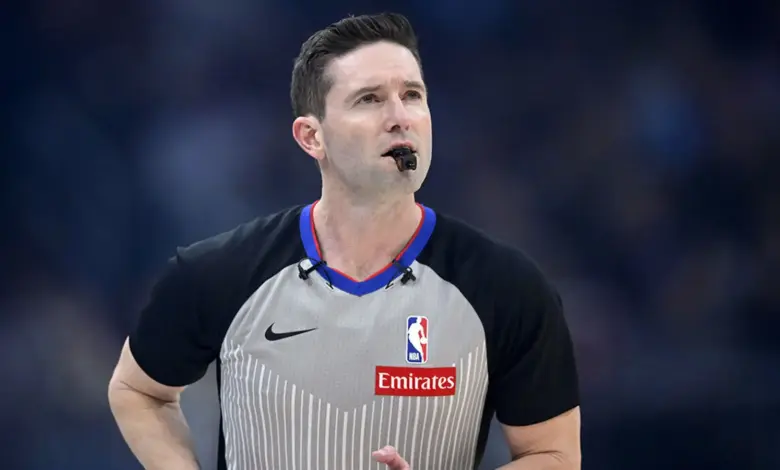
The Warriors game in Inglewood took an unexpected turn Wednesday night when official Ben Taylor had to leave with an injury, briefly shifting attention away from the score and onto the mechanics of keeping a postseason crew intact. The warriors-Clippers play-in meeting was already carrying elimination stakes, but the interruption added a rare officiating storyline. Taylor walked stiffly off the court with 8: 51 left in the third quarter, and alternate Sean Corbin stepped in after a short delay to keep the game moving.
What changed in the middle of the game
Ben Taylor exited the contest at Intuit Dome and went up the tunnel behind one basket after appearing to leave with a limp. The interruption came in the third quarter of the play-in tournament game between the Golden State Warriors and the Los Angeles Clippers. Corbin replaced him after the brief delay, taking over alongside the rest of the crew. The NBA sends a fourth alternate referee to every postseason game for situations like this, and this instance showed why that safeguard exists. The change did not reset the contest, but it did underscore how quickly postseason games can require a backup plan.
The timing mattered because the game was already tight in terms of stakes, with the Clippers holding a 61-53 halftime lead over the Warriors in the elimination matchup. Any pause in that environment draws more attention than it might in the regular season. Still, the substitution itself was procedural rather than dramatic: Taylor left, Corbin entered, and play continued.
Ben Taylor and the depth behind the officials’ crew
Taylor is an 11-year NBA veteran referee. Corbin, by contrast, is in his 31st season on the job. That experience gap did not create a problem; instead, it highlighted the league’s ability to lean on officials with substantial postseason and professional experience when needed. The substitution also reflected the value of having a dedicated alternate on hand, especially in a postseason setting where the margin for error is narrow and continuity is essential.
The situation also pointed to how officiating is structured for the playoffs and play-in games. The presence of an alternate is not symbolic. It is part of the operational design for a game that can shift quickly from routine to unusual. In that sense, the warriors matchup became a practical example of contingency planning in live competition. The crew had to adapt immediately, and the game resumed without a prolonged stoppage.
Why the interruption mattered beyond one whistle
At the center of the night was not just the injury itself, but what it revealed about the postseason environment. The Warriors entered the matchup as the No. 10 seed in the Western Conference, while the Clippers were No. 9. The winner would advance in the NBA Play-In Tournament to face the Phoenix Suns, and the loser would go home. That structure leaves little room for distraction, which is why even a brief officiating change can feel larger than it might otherwise.
Golden State also came into the game managing questions around Stephen Curry, who was on a minutes restriction while returning from a knee injury and briefly left the game before coming back. Those details did not alter the officiating issue, but they added another layer to an already pressure-filled night. In a game shaped by health management, seeding pressure, and elimination stakes, Taylor’s exit became one more reminder that postseason basketball can change in seconds.
Broader implications for postseason play
The practical lesson from the episode is straightforward: the league’s backup structure worked as intended. The presence of Corbin meant the game could continue with minimal disruption despite the sudden loss of one official. For viewers, the interruption may have looked abrupt. For the league, it was a test of a system designed to absorb exactly this kind of setback.
That matters because postseason games compress scrutiny, urgency, and consequence into one night. When a referee leaves the floor, the concern is not just about one person’s condition; it is about preserving the game’s integrity and pace. Wednesday’s incident showed that the built-in cushion exists for a reason, and that experience on the officiating side can be just as important as depth on the roster.
The broader question now is simple: if the warriors are forced into another high-pressure night, how much else in postseason basketball can shift before the game itself starts to feel different?