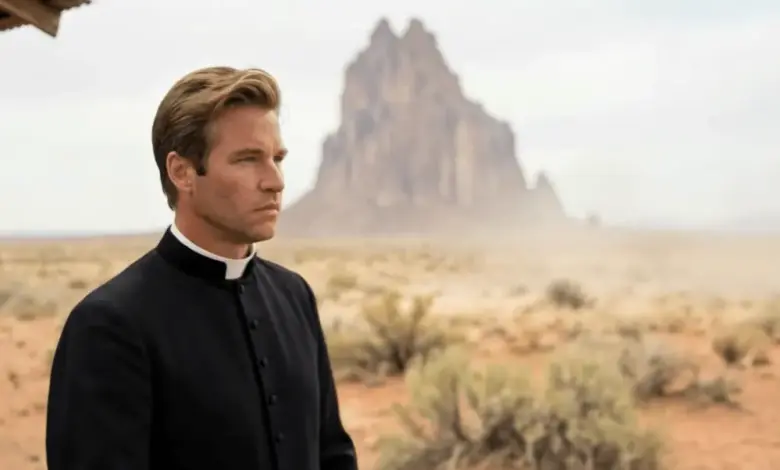
The new val kilmer trailer from As Deep as the Grave does more than preview a historical drama. It places a recreated performance at the center of a wider industry argument about whether generative tools can be used to preserve an actor’s presence without crossing an ethical line. The filmmakers say the project was built around consent, compensation and collaboration, but the footage shown at CinemaCon also makes the question feel immediate: what does authorship mean when an actor can appear in multiple ages on screen after death?
Why the trailer matters now
The trailer debuted Wednesday at CinemaCon in Las Vegas, where the film’s use of AI became one of the most discussed elements of the presentation. In the footage, Kilmer appears as Father Fintan, a Catholic priest and Native American spiritualist, in a role the filmmakers say he had already signed on to years earlier. Because he was too sick to shoot, the production used generative AI with the cooperation of his estate and his daughter Mercedes to complete the performance.
That choice matters because the film lands at a moment when Hollywood is still weighing how digital replication should work in practice. The production team says it relied on union guidelines and used archival material supplied by Kilmer’s family. Those facts are central to the project’s defense, but they also frame a larger creative shift: technology is no longer being used only to enhance a performance after filming, but to reconstruct one that could not be completed in person.
What the footage shows
The trailer presents val kilmer in several forms, including as a spectral figure and as a younger man of the cloth. One line, delivered to a child, stands out because it makes the digital presence feel narratively integrated rather than simply novel: “Don’t fear the dead and don’t fear me. ” The scene is brief, but it signals how fully the film leans into the idea that the actor’s image can be adapted across time within a single story.
Coerte Voorhees, the writer-director, said the role was substantial and would appear for more than an hour of the film. He also said the project was designed around Kilmer and drew on his Native American heritage and his ties to the Southwest. That makes the AI use less like a last-minute technical patch and more like a structural decision, one that shaped the movie before production ran into the realities that prevented Kilmer from shooting his part.
val kilmer, ethics and the new production model
The ethical argument is built on a narrow claim: the filmmakers say they used the technology only because they needed to, and only after securing permission from the estate. Producer John Voorhees described the approach as following “consent, compensation and collaboration, ” a formulation that captures the production’s attempt to stay within established labor boundaries while still pushing into unsettled creative territory.
Still, the project underscores a tension that cannot be ignored. The same tools that made this performance possible could be used to reduce costs or replace living performers in less transparent ways. In this case, the filmmakers insist the opposite happened: the family’s archival material was used, the estate was paid, and the union framework was followed. That does not resolve the broader debate, but it does show how future cases may be judged — not just by the final image, but by the process behind it.
Expert perspectives and the wider industry signal
Coerte Voorhees stopped short of calling the recreated role a Val Kilmer performance, saying instead that Kilmer influenced it. That distinction is important because it draws a line between a direct acting credit and a digitally constructed presence informed by an actor’s prior work. Mercedes Kilmer offered the most personal defense of the project, saying her father would have wanted to be included and believed emerging technologies could expand storytelling possibilities.
The film also includes Abigail Lawrie, Tom Felton, Abigail Breslin, Tatanka Means, Jacob Fortune-Lloyd, Wes Studi and Finn Jones, and the trailer pairs the AI footage with large-scale imagery: cliffside excavations, buffalo moving across a plain and a car forcing through rapids. The result is not just a technical showcase. It is a signal that the industry may increasingly frame AI not as a side issue, but as part of the language of mainstream filmmaking.
Regional and global impact
Because the trailer was introduced at CinemaCon, its impact reaches beyond one film. It enters a room full of distributors, exhibitors and decision-makers at a moment when the entertainment business is still defining how far generative tools should go. If this approach is accepted as an exception tied to consent and necessity, it may become a template for limited use in future productions. If it is seen as a warning, it could harden resistance to digital reconstruction of deceased performers.
For audiences, the immediate effect is simpler: the val kilmer imagery changes how the film is read before release. The historical drama must now compete with its own method, and that may be the strongest sign of where the conversation is headed. As the technology becomes more capable, the harder question is not whether it can recreate a performance, but how many safeguards will remain once it can.
For Hollywood, the issue is no longer hypothetical. The trailer suggests a future in which the line between preservation and replacement is thinner than ever — and the next test will be whether the industry can keep that line visible.