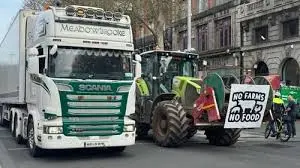
The farmer fuel price protest is gaining urgency as slow-moving convoys crossed roads in the Republic of Ireland on Tuesday, with drivers pressing the government to act on rising petrol and diesel costs. The protests came as new fuel tax cuts were set to take effect at midnight on Tuesday ET, but motorists were still facing sharply higher prices than they did in February. The strain is now reaching farmers, truck drivers, and commuters alike, as energy costs remain a live political issue in Dublin.
Slow-moving convoys disrupt roads and daily travel
On Tuesday, a number of slow-moving convoys moved through main roads leading to Dublin and near other large urban areas, causing motorists to be warned to allow extra time for journeys. Vehicles involved in the protest were parked or moving slowly on O’Connell Street in Dublin, while Dublin Airport told passengers to prepare for disruption while traveling to the airport.
The protest movement was described by participants as a response to what they called “crazy” fuel prices. Sonny Boyd, a truck driver, said the demonstrations were aimed at forcing government intervention. He said, “We need it capped. We need carbon tax to be gone. We just need the government to step in and help us because we can’t do this any longer. ”
Prices remain well above February levels
The latest government cut in excise duty, worth 10 cent, was due to take effect at midnight on Tuesday ET. Even with that change, the expected price drops would still leave motorists far worse off than they were six weeks earlier. The latest market pressure has been linked to the situation in the Middle East and the blockade of the Strait of Hormuz, which has driven a rapid rise in global oil prices.
By the end of this week, petrol was expected to cost about €1. 82 a litre on a Dublin 7 forecourt, while diesel was expected to fall to about €2. 08. In February, the average price of petrol was €1. 73 and diesel was €1. 72, showing how sharply fuel costs have climbed since the start of the crisis.
The farmer fuel price protest is also unfolding against the backdrop of broader cost pressure on goods and services. Eamon Curley, a beef farmer from County Meath and chairperson of the Beef Plan Movement, warned that food prices will “jump up” if the Irish government does not act. “The farmers drive tractors, the builders drive diggers. Green diesel is our blood and what they’re doing at the moment with these high taxes, they’re kneeling on our throats, ” he said.
Government faces pressure as energy meeting looms
John Dallon, a farmer and agriculture contractor from County Kildare, said the government should take the protests “seriously” and added, “We’re calling on the government here to save our economy. ” Tánaiste Simon Harris is planning to hold a meeting on Wednesday dedicated to energy, placing the issue at the center of government attention in ET terms this week.
Brent crude has also surged, with the benchmark price rising by over 9. 1 percent to near $104 a barrel. If prices rise further, fuel costs in Ireland could climb again quickly, even after the excise duty reductions.
What happens next for the farmer fuel price protest
The farmer fuel price protest is likely to keep pressure on ministers as the excise cut takes hold and road disruption continues to draw public attention. The immediate test will be Wednesday’s energy meeting and whether the government signals any further response to fuel costs in ET this week, while motorists and farmers wait to see if prices stabilize or climb again.