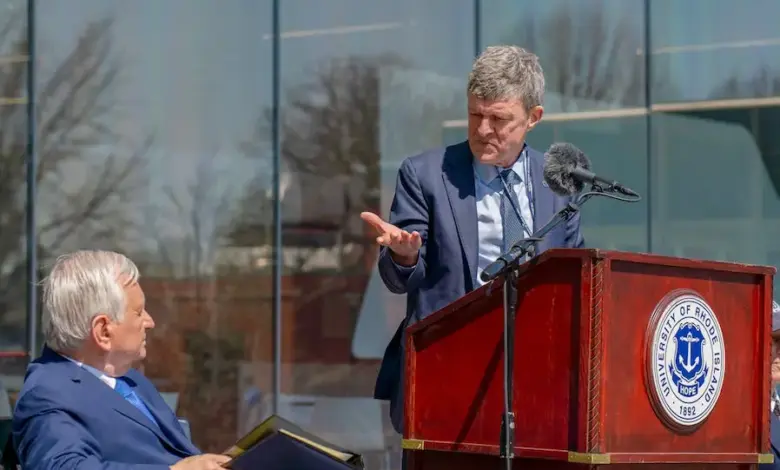
On a spring day in Kingston, a physics department event became something larger than a campus program. During world quantum day, elected officials, technology leaders, and university researchers gathered at the University of Rhode Island to discuss how quantum computing reaches beyond laboratories and into society, the arts, security, and the future of student research.
What made World Quantum Day feel different on the Kingston Campus?
The setting was practical, not ceremonial. Visitors first toured the future Laboratory for Quantum Computing and Technology in URI’s Fascitelli Center for Advanced Engineering, a space scheduled to open in 2028. The planned facility will include low-temperature infrastructure for quantum computing, a clean room for making computing elements sensitive to the environment, and an area for reviewing controlled unclassified information.
That campus tour framed the broader discussion that followed. Hosted by URI’s Department of Physics, the fifth annual event brought together public officials and technology leaders for a conversation about how quantum computing affects research, industry, innovation, and society. The gathering was part of a worldwide celebration launched by quantum scientists from more than 65 countries to build public understanding of quantum physics and its growing impact.
How did speakers connect quantum science to public life?
The questions on stage moved well beyond technical jargon. Presenters addressed whether guardrails are needed for quantum computers, how quantum computing intersects with the humanities and the arts, whether reality is really real, and how post-quantum encryption can help protect vital information from attacks by a quantum computer.
Guest presenters included Rhode Island state Sen. Victoria Gu, D-Westerly, chair of the Senate Committee on Artificial Intelligence and Emerging Technologies; Ishann Pakrasi of Amazon Web Services; Christopher Savoie ’92, founder of SiC Systems and a URI alum; and Charles Robinson of IBM. Suhail Zubairy, the Munnerlyn/Heep Endowed Chair in Quantum Optics at Texas A&M University, delivered the keynote address.
The mix of voices gave the day a concrete human dimension. State policy, corporate research, and university training all shared the same stage, making world quantum day less about abstraction and more about who gets to shape the technology and who will live with its effects.
Why are student grants part of the story?
URI’s physics department used the event to announce a new quantum-humanities mini-grant program for students. Undergraduate and graduate students will be eligible for financial support for quantum computing research work. The grants are supported by Amazon Web Services and URI’s Institute for AI and Computational Research.
Each undergraduate award will provide $1, 000 to the student researcher and $250 to the faculty advisor. The announcement matters because it links the university’s public conversation to hands-on opportunity. Instead of leaving quantum computing as a topic for experts only, the program gives students a path into the field while encouraging work that explores the intersection of quantum science and the humanities.
For a campus event built around public understanding, that shift is significant. It recognizes that the future workforce will not only need technical skill, but also the ability to think about ethics, culture, and the social consequences of fast-moving tools.
What did officials say about the bigger stakes?
U. S. Sen. Jack Reed, D-R. I., said the event celebrates URI’s progress toward leadership in the quantum realm. He said quantum computing and information sciences will be critical for the nation’s competitiveness, both economically and in national security and military terms, with URI leading the way. Reed also said the best path forward is a partnership between government, industry, and academia.
The university’s quantum computing research and workforce development initiative began in 2021 and was supported by a $1 million directed federal Commerce, Justice and Science earmark secured by Reed. That history gives the day another layer: the event was not only a celebration, but also a marker of a multi-year institutional effort now moving from planning toward infrastructure and training.
Seen that way, world quantum day at URI was not a single program on a Friday. It was a snapshot of how a university, public officials, and industry partners are trying to make quantum science legible to the public while building the next stage of research at home. In Kingston, the future laboratory stands as both promise and question: who will use it, who will benefit from it, and how widely will the public be brought into the conversation?