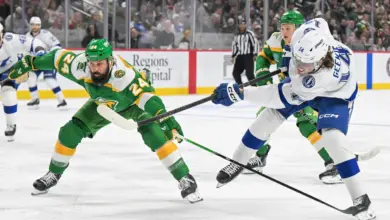
In the middle of a title defense, a player can go from central to peripheral almost without warning. For Aaron Wiggins, that shift has been visible in the minutes, the shots, and the late-game stretches that now seem to belong to someone else. The story of aaron wiggins is no longer about an early-season surge; it is about what happens when a trusted role narrows just as the postseason approaches.
What changed for Aaron Wiggins?
Wiggins opened the season as one of Oklahoma City’s most trusted scoring options, posting 14. 8 points per game while shooting 45. 9 percent from the floor and 41. 7 percent from deep in the first few weeks. He was playing 24. 0 minutes per game through a little more than the first three months, and his usage suggested real stability in the Thunder rotation.
That picture has changed. His minutes have fallen to 18. 9 after the addition of Jared McCain ahead of the February 5 trade deadline, and his production has followed. He is now averaging 7. 8 points on 40. 1 percent shooting and 27. 2 percent from distance. Since beginning the year with 8. 8 shot attempts per game, he has topped eight attempts only four times since the start of March.
Even in a blowout win over the Lakers, Wiggins took only seven shots while playing 20 minutes. In another recent game against the Lakers, he did not enter until Oklahoma City had already built a large lead. The pattern is clear: his early-season role has faded, and the current rotation has little space left for it to return.
Why does this matter for the Thunder title defense?
The larger issue is not just one player’s usage. It is how a championship roster changes when injuries, returns to full strength, and in-season shakeups alter the pecking order. Wiggins was once filling a high-usage job at a time when the Thunder needed it. Now, with less than two weeks separating the team from the playoffs, that role appears to have been absorbed by the shifting demands of the season.
That is the human reality behind a team’s success. Players do not simply stay fixed in one version of themselves. A hot start can become a memory, and a reliable scorer can become an occasional piece. In Wiggins’ case, the numbers show a steady reduction, but the broader meaning is harder to ignore: a contender’s depth can create opportunity, then quietly take it away.
Could a draft decision shape what comes next?
The Thunder may already be looking ahead. One path forward points to Santa Clara freshman Allen Graves, described as a potential replacement option in this June’s NBA Draft if he declares for the 2026 class. He is portrayed as a stretch four who shoots over 40. 0 percent from behind the arc, with all of his made threes coming off assists. He also averages 2. 8 offensive rebounds a game and brings a post game built around hook shots and floaters.
That profile matters because it mirrors what a team often seeks when a familiar rotation piece fades: size, spacing, and reliability. The question is not whether the Thunder need another player. It is whether they need someone who can fill the same kind of minutes and make the same kind of small but useful plays that once made Aaron Wiggins so valuable.
What are the Thunder and their options trying to solve?
For the Thunder, the challenge is to balance the present with what may come next. Wiggins remains part of the story, but the evidence suggests his earlier role is gone. If the team is searching for a seamless replacement, Graves is the name now tied to that possibility, though his path depends on whether he actually declares.
There is no tidy ending yet. The Thunder are still in a title defense, and a player who once helped steady it is now waiting farther down the bench. For Aaron Wiggins, that can feel like a loss of gravity. For Oklahoma City, it may simply be the cost of becoming deeper, healthier, and harder to define.
When the playoffs arrive, the opening scene will likely look familiar: a championship team, a crowded rotation, and a bench that looks different than it did in the first weeks of the season. But for aaron wiggins, the meaning of that scene has already changed.