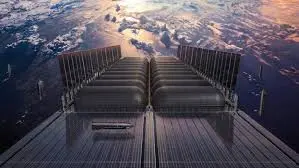
The international space station has become the reference point for nearly every serious discussion of life in orbit, but one new design competition is pushing that benchmark into far larger territory. The Aurelia Institute has named designer Will Root’s Tycho concept the winner of its inaugural Aurelia Prize in Design for Space Urbanism, with the proposal claiming 10 times more interior space than the International Space Station. The result matters because it signals a shift from incremental habitat thinking toward models built around permanence, scale, and continuous operation.
Why the Tycho concept changes the conversation
The award comes with a $20, 000 first prize and an invitation for Root to join a parabolic research flight through Aurelia Institute’s Horizon Zero Gravity Program. His designs will also be added to the organization’s Space Architecture Trade Study, described as a public resource for academics, industry professionals, and the broader space architecture community. That placement gives Tycho significance beyond a single design contest: it becomes part of a formal reference set for future work on orbital habitation.
The competition drew more than 200 complex space habitat proposals from an international pool of designers across multiple disciplines. Ariel Ekblaw, chief executive of Aurelia Institute, said the response reflected strong interest and expertise across industry and academia. For a field still defined by narrow practical limits, the volume of submissions suggests that the debate around the international space station is no longer only about replacement, but about what a next-generation orbital environment should look like.
Inside the design logic behind the space station proposal
Root described Tycho as filling the “missing middle” between smaller modular systems and larger theoretical habitats associated with earlier space settlement ideas. That framing is central to the design’s appeal. Rather than presenting orbital living as a binary choice between modest platforms and enormous speculative structures, Tycho argues for something scalable: a station designed to grow incrementally, operate continuously, and support life and industry at civic scale.
Two technical ideas define the proposal in the available materials. First, the station is designed to operate in a Terminal Orbit, which Root says enables near-continuous solar generation while avoiding the need to move solar panels and a radiator with the Sun. Second, in Low Earth Orbit, the design uses a five-kilometer cable-stayed flexible solar array that is passively tensioned by gravity-gradient forces with oscillation damping, reducing reliance on active attitude control while preserving orientation and planetary alignment.
The Aurelia Prize judges highlighted the way the design uses conditions unique to space to support its size. Tycho includes an origami-like structure that expands from a compact storage container into a much larger living space. The patent-pending RootShell pressure-vessel technology is designed to deploy modules exceeding 250, 000 cubic meters with a single Starship launch, avoiding the compromises of soft inflatables. In practical terms, that scale is what separates a concept study from a provocative vision: it is a claim about manufacturability, launch strategy, and orbital assembly all at once.
What the International Space Station comparison really means
The comparison with the international space station is not just a matter of size. It also exposes how the conversation around orbital infrastructure is evolving. The competition announcement explicitly invited concepts that could resemble the International Space Station, but on a much larger scale, or even deep-space structures positioned at gravitationally stable Lagrange points. That range matters because it shows the field is now evaluating habitat design through utility, benefit to Earth, and operational efficiency, not simply technological novelty.
Tycho’s promise is that larger stations may no longer have to be treated as purely theoretical. Yet the design still sits within a competition framework, which means the available facts show ambition rather than deployment. The deeper implication is that future station planning may need to reconcile two competing demands: the simplicity required for launch and assembly, and the permanence required for human civilization in orbit.
Expert reaction and wider impact on orbital habitat planning
Ekblaw said the jury was impressed by the “quality, variety, and sheer creativity” of the submissions. That judgment is important because it places creative breadth alongside engineering plausibility. In a field often constrained by mass, volume, and cost, the ability to imagine beyond current station logic becomes a strategic asset, not a distraction.
For the wider space architecture community, the broader consequence is clear: the international space station is still the standard reference, but it is no longer the only one shaping the future conversation. The Aurelia Prize has turned a design contest into an implicit policy signal about scale, continuity, and public resource-building. If habitats are judged by utility and efficiency as much as by ambition, future proposals may be expected to explain not only how they launch, but why they should exist as living systems in orbit.
That is why Tycho resonates now. It does not replace the international space station as a fact of current orbital life, but it reframes what comes after it. The open question is whether the industry is ready to move from landmark station thinking to habitats designed for growth, permanence, and civic-scale use.