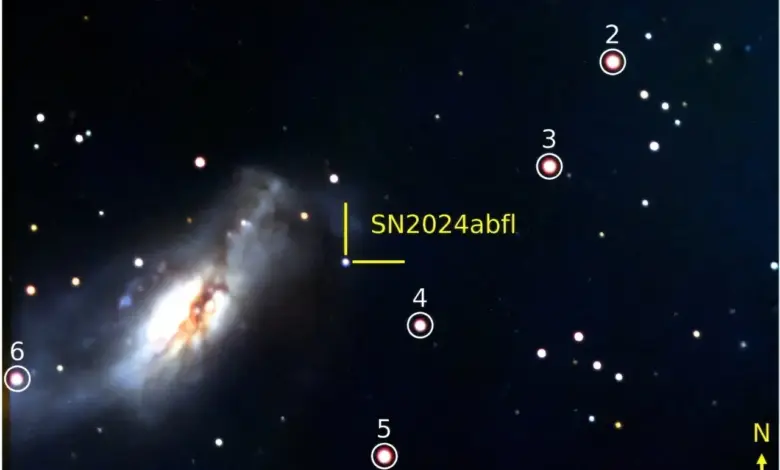
The supernova SN 2024abfl is turning attention toward a narrower but important question: what does a faint, long-lasting plateau reveal about the kind of star that exploded? A new observational campaign led by astronomers from the Chinese Academy of Sciences used the Lijiang 2. 4-m and Xinglong 2. 16-m telescopes to examine this unusual Type IIP event, and the results point to a low-mass core-collapse origin rather than a standard, well-behaved example of the class.
What Happens When a Type IIP Supernova Breaks the Pattern?
Type IIP supernovae are normally expected to stay bright on a plateau for about 100 days before fading. SN 2024abfl did something close to that, but not in a routine way. Its plateau lasted about 110 days, while its luminosity remained unusually low. The study places the event at the faint end of the low-luminosity Type IIP population, even when the larger distance estimates for its host galaxy, NGC 2146, are used.
That matters because the light curve and spectra together narrow the range of plausible progenitors. The supernova also showed unusually low expansion velocities, with iron-line speeds of around 1, 200 km/s at 50 days after the explosion. Alongside the plateau shape and the drop from plateau to tail, that profile makes the explosion look less like a standard Type IIP and more like a low-mass core-collapse event. The word supernova fits, but the usual expectations do not.
What If Distance Uncertainty Is Part of the Story?
One reason the object remains interesting is that the host galaxy distance is not settled cleanly. The new estimate for NGC 2146 is about 28. 5–32. 4 million light years away, while earlier work placed it at 31–54. 4 million light years. The gap is tied to the galaxy’s disturbed morphology, likely shaped by tidal interactions with a low-surface brightness companion. That disturbance complicates distance determinations and therefore affects how astronomers interpret the progenitor mass, absolute magnitude, and explosion energy.
Even so, the supernova remains intrinsically faint under either distance range. The inferred plateau luminosity is about 100 duodecillion erg/s, and the synthesized radioactive nickel mass is extremely small, estimated at 0. 002–0. 004 solar masses. In practical terms, the object is not just dim; it is dim in a way that aligns with the idea of a low-mass origin.
What If the Key Clues Point to a Low-Mass Core?
The observational combination is what makes SN 2024abfl notable. The research team focused on the plateau color and duration, the magnitude drop between plateau and tail, and the spectroscopic properties. Taken together, those features support a low-mass core-collapse interpretation more strongly than an electron-capture scenario in the paper’s assessment.
| Observed feature | What it suggests |
|---|---|
| Plateau lasting about 110 days | Long-lasting Type IIP behavior |
| Very low plateau luminosity | Faint end of the low-luminosity Type IIP group |
| Nickel mass of 0. 002–0. 004 solar masses | Unusually small radioactive yield |
| Fe II velocity around 1, 200 km/s at 50 days | Exceptionally low expansion speed |
That combination does not close the case on every detail, but it does sharpen the forecast for how researchers will read similar events. A supernova like this is a reminder that light-curve shape alone is not enough; the spectrum, velocities, and host-galaxy environment all have to be read together.
What If More Peculiar Supernovae Become the Rule for the Exception?
The larger lesson is not that every Type IIP supernova will look like SN 2024abfl. It is that some core-collapse explosions may sit at the edge of familiar categories, where the standard assumptions about hydrogen retention, luminosity, and velocity are less reliable. For researchers, that means the next step is not broad certainty but tighter classification and better multi-epoch observation.
The most likely near-term outcome is continued reclassification work: more faint events will be tested against the same markers, and the distance problem in disturbed host galaxies will remain a practical obstacle. The best-case scenario is that similar studies will clarify how low-mass core-collapse explosions differ from other type II events. The most challenging case is a lingering ambiguity in which distance uncertainty blurs the physical interpretation and keeps the origin of some faint supernovae open.
Who wins is clear enough. Astronomers gain a cleaner example of how to connect plateau behavior, nickel yield, and velocity structure in one object. Who loses is the comfort of simple categories. For readers, the takeaway is straightforward: the supernova is not just another dim explosion, but a useful signal that the boundary between familiar classes can be thinner than expected.
As 2026 approaches, the value of SN 2024abfl is that it turns a peculiar light curve into a forecast about future work. The next set of observations will likely focus less on whether it is unusual and more on how many other supernovae share the same hidden structure.
supernova