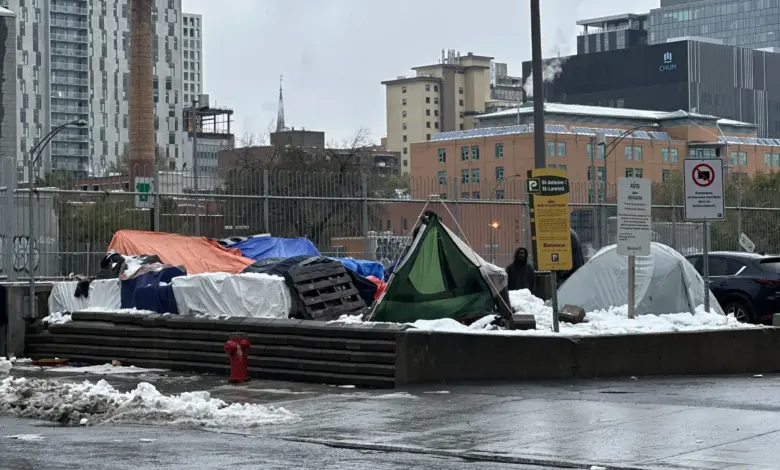
Homelessness in Quebec has reached a turning point as the province’s latest count shows a sharp rise between 2022 and 2025, with the pressure spreading well beyond Montreal. The April 2025 count found 12, 077 people experiencing homelessness across Quebec, up 20 per cent from 2022 and up by 1, 873 people overall.
What Happens When the Growth Moves Beyond Montreal?
The most important shift is not only the increase in total numbers, but where the increase is happening. Montreal still has the largest concentration, with an estimated 5, 036 people experiencing homelessness, yet its growth over the period was only 6. 7 per cent. By contrast, several regions outside the metropolis saw much steeper increases.
Laval’s homeless population rose 59. 4 per cent, the Laurentians jumped 73. 7 per cent, and Abitibi-Témiscamingue more than doubled at 119. 1 per cent. The provincial ministry said the exercise shows homelessness now extends well beyond major urban centres, especially outdoor homelessness, which is being observed in all regions.
What Does the 2025 Count Show About Where People Are Staying?
The count, carried out on the night of April 15, 2025, gives a detailed picture of how people were spending that night across Quebec. Of the total population counted, 9, 518 people were staying in shelters and other temporary resources. Another 246 were in hospital, and 426 were being held in police station jails or detention centres.
The count also found 411 people in encampments and 1, 476 people spending the night outside but not in an encampment. Montreal had more than 800 people staying outside, around 44 per cent of everyone sleeping outside in Quebec. Its rate of homelessness stood at 229. 5 unhoused people per 100, 000 residents, compared with a provincial average of 133. 2.
| Region | Change from 2022 to 2025 | Notable detail |
|---|---|---|
| Montreal | +6. 7% | More than 5, 000 people experiencing homelessness |
| Laval | +59. 4% | Lowest rate in Quebec at 64. 7 per 100, 000 residents |
| Laurentians | +73. 7% | Largest increase in number added: 331 people |
| Abitibi-Témiscamingue | +119. 1% | Fastest growth in the province |
What Forces Are Reshaping Homelessness Across the Province?
The pattern suggests a broader provincial shift rather than a problem contained in one urban centre. Since 2018, Quebec’s homeless population has increased by about eight to 10 per cent a year, and the number of people spending the night outside has been rising faster in the most recent period than it did previously.
Between 2022 and 2025, the number of people sleeping outside rose by around 14 per cent a year, faster than the roughly 10 per cent annual pace observed between 2018 and 2022. Shelter use also changed more slowly, increasing by six per cent a year between 2022 and 2025, compared with eight per cent a year in the earlier period. That contrast points to a more visible and geographically dispersed challenge.
What Should Readers Watch Next?
The current count is only part of the picture. The ministry said the complete results of the 2025 count, expected in the fall of 2026, will provide a deeper understanding and support service planning and prevention efforts across the province. For now, the clearest signal is that homelessness is no longer rising only in the places that already carried the biggest burden.
Best case, the new numbers drive more targeted planning in the regions where the jump has been steepest. Most likely, the data will prompt a broader, uneven response that still leaves outdoor homelessness visible across Quebec. Most challenging, the regional spread continues to widen faster than services can adjust. Readers should understand that homelessness is becoming more decentralized, more visible, and harder to contain in any single area. Homelessness