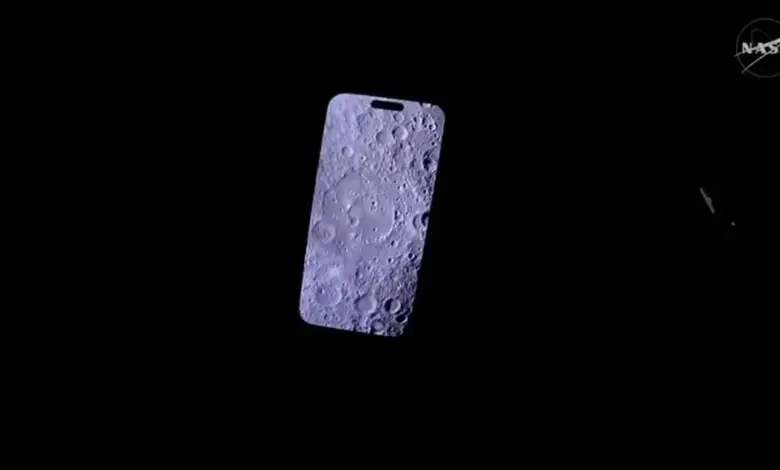
Wallpaper is suddenly part of the Artemis II story in a way few expected: the mission’s most striking images are not just historic records, but desktop-ready frames from humanity’s return to lunar orbit. NASA’s Artemis II astronauts captured Earth, each other, and spacecraft moments on iPhone 17 devices that were cleared for the flight, creating a visual archive that feels personal and public at once. The result is a rare blend of spaceflight discipline and everyday technology, with images now freely available for anyone who wants to bring the mission onto a phone or PC.
Why Artemis II images matter now
The timing is what gives these images their force. Artemis II has already completed a flyby of the far side of the Moon and broken the record for the farthest-ever human spaceflight. That alone would make the mission noteworthy. But the fact that the crew used iPhones to document it adds a second layer: the story is not only about engineering and orbit, but about how modern crews record history in real time. The Artemis II mission is also described as NASA’s landmark return of humans to lunar orbit for the first time since 1972.
The crew includes NASA astronauts Reid Wiseman, Victor Glover, and Christina Koch, along with Canadian Space Agency astronaut Jeremy Hansen. Their journey aboard the Orion spacecraft is expected to last around 10 days in total. Within that compact window, the public has gained access to high-resolution images of Earth from space, crew training moments, and spacecraft details. NASA has made those images freely available, turning a mission archive into a source of visual material for everyday screens.
The human side of a technical mission
The detail that stands out is not only the hardware, but the decision to bring smartphones on board. NASA Administrator Jared Isaacman made the intentional decision to permit smartphones, saying the aim was to give crews another way to capture personal photos while also challenging older processes and qualifying modern hardware for spaceflight on an expedited timeline. That statement matters because it frames the decision as operational, not decorative.
Reid Wiseman also made clear that taking photos in space is not simple. During the livestream, he compared it to trying to photograph the Moon from a backyard, saying it feels like trying to take a picture of Earth in the same difficult way. That is a useful reminder that even a scene as large as Earth can be tricky to frame when you are moving through space at extraordinary speed. In that sense, the wallpaper-friendly images are not casual snapshots; they are the product of a demanding environment and a crew adapting to it.
The mission has also turned the camera back on the astronauts themselves. Wiseman and Koch were seen posing with Earth in silhouetted shots, while the crew floated a phone back and forth to take images for one another. Those moments matter because they show the mission as lived experience, not just a sequence of milestones.
What the public gets from the image library
The image collection is broad enough to serve different uses, from training views to Earth photography. NASA’s library contains hundreds of Artemis II photos in resolutions high enough for any monitor, which is why the phrase wallpaper is more than a casual label here. The images are already positioned as desktop backgrounds, and setting them on a Windows PC reportedly takes less than a minute once the image is chosen and downloaded from the official lunar collection.
That accessibility changes the relationship between space imagery and the public. Instead of waiting for a polished campaign or a limited release, viewers can take a high-resolution image from a mission still in progress and place it on a personal screen. In practical terms, the mission’s visual output becomes a daily reminder of how far the crew has traveled. In editorial terms, it also helps explain why wallpaper has become part of the broader Artemis II conversation.
Broader impact beyond one screen
The wider significance is not only aesthetic. High-resolution mission imagery gives the public a clearer sense of scale, distance, and crew perspective. It also shows that NASA is comfortable pairing legacy exploration goals with modern capture tools. The decision to allow iPhone 17 devices, which do not connect to the internet, suggests a controlled use of consumer technology inside a highly managed mission.
For the regionally and globally minded audience, the image release is a reminder that the mission’s impact crosses borders. The crew includes a Canadian Space Agency astronaut, and the milestone concerns the return of humans to lunar orbit, a threshold that carries international weight. The images therefore function on two levels: as a personal record for the astronauts and as a shared visual marker for a mission that aims far beyond one agency or one country.
The larger question is whether this becomes a template for future crews. If modern hardware can be qualified quickly and used to document a mission this significant, the line between professional space instrumentation and everyday capture tools may keep narrowing. For now, the Artemis II archive offers a rare chance to turn a record-setting flight into wallpaper that is both visually striking and historically grounded. How often does a screen background also carry the feeling of a first in more than 50 years?