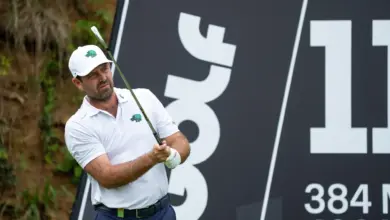
Justin Rose arrives at Augusta National with the same uncomfortable truth that has followed him for years: he keeps getting close enough to feel the finish, but not close enough to cross it. That is why justin rose is again one of the defining names around the Masters conversation. He is a three-time runner-up, he has lost two playoffs at Augusta National, and he is back after last year’s playoff defeat to Rory McIlroy. For Rose, the challenge is no longer about proving he belongs. It is about proving that closeness can still become victory.
A familiar place, a familiar burden
Rose’s Augusta record is built on repeated contention rather than one defining breakthrough. He was second in 2015, he has also finished runner-up in 2017, and last year he was edged in a playoff after McIlroy birdied the 18th. That sequence gives Rose a rare and awkward distinction: his name appears twice on Augusta’s tournament record boards beside playoff losses. In Masters history, only Ben Hogan also lost two playoffs, and Hogan still had multiple wins to soften the blow.
That history matters now because Rose is 45 and playing his 21st Masters. The present tournament is not a reset so much as another test of whether experience can finally overpower memory. Rose has held a share of the lead nine separate times at Augusta National, which underlines both his consistency and the thin margin between excellence and disappointment. The story of justin rose at Augusta is not that he has fallen short once; it is that he has repeatedly placed himself within reach.
What the numbers say about Justin Rose
The wider context is strong enough to justify the belief that he is not simply a sentimental pick. Rose has finished T20 or better in 12 of 20 career starts at Augusta National, a record that marks sustained relevance over time. That consistency explains why bettors have been drawn to him again this year and why one bookmaker has identified him as its largest liability heading into the tournament. In betting terms, that is a measure of exposure; in golf terms, it is a sign that the market sees a player with enough Augusta familiarity to threaten the outcome.
There is a deeper point here as well. Rose’s own words suggest that he has tried to manage the emotional weight rather than chase away the disappointment. He says a player cannot make a major too important in the moment, because heartache is part of the path. That is not resignation. It is a competitive philosophy. Rose is arguing that the route to winning requires acceptance of the risk of losing, and that the hard part is putting yourself in position again after being hurt.
Justin Rose, heartache and the Augusta ceiling
The analysis around justin rose is therefore less about whether he is good enough and more about whether Augusta allows repeated opportunities to matter. He has already shown that he can contend across multiple eras of the tournament. What he has not yet done is turn those runs into a Green Jacket. The current moment is shaped by that tension: Rose can live with the fact that he did everything he could last year, but the last step remains unmade.
That is why his own framing is so revealing. He says he does not need to create a different feeling at Augusta because he enjoys the place and believes he has already done enough to win there. The implication is subtle but important. He is not searching for a new identity; he is trying to convert an existing one. The question is whether familiarity at Augusta National becomes an advantage or a reminder of what has not yet happened.
Expert perspectives and the wider Masters picture
Lee Phelps, spokesperson for William Hill, said the tournament is “already on edge” over who will wear the Green Jacket on Sunday evening, adding that “Justin Rose remains the worst possible result for our books” because of his ability to contend at Augusta National. That view reflects the betting market’s reading of his chance: not certain, but dangerous enough to matter.
The broader field adds to that pressure. McIlroy is among the major liabilities after his recent rise in the market, while Matt Fitzpatrick and Robert MacIntyre have also drawn support. But Rose remains central because his case is built on evidence, not projection. He has done this before, and he has done it often enough to make the possibility feel real.
Nick Price’s 63, still unbeaten at Augusta National 40 years after it was set, is a reminder that some records endure because the course resists perfection. Rose’s challenge is different but related: can he finally turn endurance into a single defining moment, or will justin rose remain the tournament’s most persistent almost-champion?