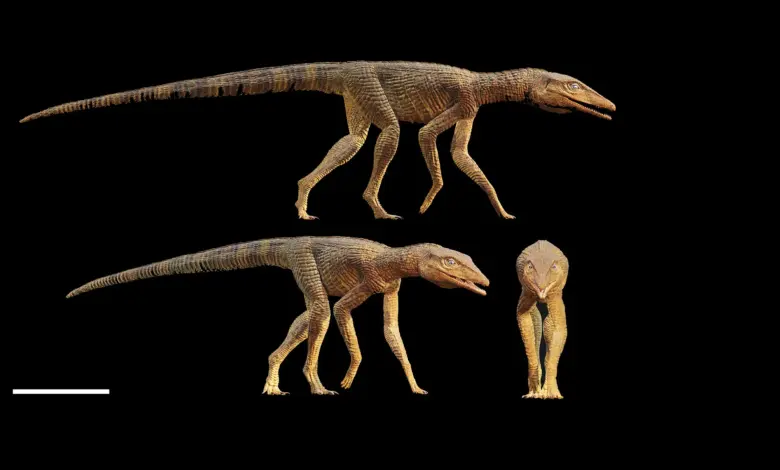
For decades, one fossil sat in plain sight. Now, that crocodiles story is turning on a recheck of two stone blocks from England, where a 215-million-year-old animal has been identified as a fast, land-running relative with a body built more like a sprinting hunter than a river ambusher. The finding matters because it suggests early croc relatives were already diverging into different running styles long before the end-Triassic die-off reshaped life on Earth.
What the fossil from England changes
The specimen came from Cromhall Quarry in southwest England and had been collected nearly 60 years ago. Working through the blocks at the Natural History Museum in London, Ewan Bodenham determined the animal was not Terrestrisuchus gracilis after all. The recheck revealed 13 anatomical differences, many in the wrists and limbs, with shorter, stockier bones pointing to a different mode of movement. That evidence led to a new name, Galahadosuchus jonesi.
The discovery is not just about one specimen. It shows that early crocodile relatives were already more diverse than a single body plan suggests. In this case, the animal appears to have been a fast ground predator, not a slow, water-bound hunter. Its long, slim limbs and upright posture fit a life spent entirely on land, unlike living crocodiles.
Crocodiles, speed, and a warmer Triassic landscape
The broader context is a Triassic Britain shaped by cracks and cavities in limestone that trapped bodies, bones, and sediment over long stretches of time. Those karst spaces, later filled as surface remains washed underground, preserved a fossil record that also includes early dinosaurs and several other small reptiles. That shared record gives researchers a way to compare animals living in the same region, rather than treating each skeleton as an isolated clue.
For this animal, the details point to a predator adapted for pursuit. Small prey likely filled its menu, including reptiles, amphibians, and early mammals moving through dry undergrowth in a hotter landscape. The body plan looks less like a river ambush hunter and more like a quick runner, which makes the crocodiles family tree look more experimentally built than the modern image suggests.
Why the anatomy matters
Several of the clearest differences were found in the wrist bones, where the animal looked shorter and sturdier than its close relative. Forelimb proportions also stood out because the lower arm bones were relatively longer than in one classic Terrestrisuchus specimen. Many other bones remained strikingly similar, which explains why the fossil had stayed grouped with that animal for so long.
The analysis also reinforces a larger point: early members of Crocodylomorpha spent their lives entirely on land. Long, slim limbs gave these animals a body built for speed, while an upright posture kept the legs moving beneath the body. In that sense, the fossil adds a fresh layer to the story of crocodiles as a lineage whose earliest chapters were written on dry ground rather than in water.
Expert perspectives on an overlooked species
Ewan Bodenham, working at the Natural History Museum in London, showed that a specimen once assigned to one species belonged elsewhere. On that evidence, the team named a new species without claiming that every branch of the family tree is settled. That caution matters. The fossil resolves one identity problem, but it also opens a larger question about how early croc relatives moved and diversified.
The best reading of the evidence is measured: this was a fast, land-running form, likely a quadrupedal hunter with a stable gait and a springy stride. The study does not close the case on early crocodile evolution. Instead, it suggests the group was already exploring more than one successful way to run before the end-Triassic die-off.
Regional and global implications
In regional terms, the fossil strengthens the importance of southwest England as a window into Triassic ecosystems. In global terms, it broadens the picture of crocodiles as a lineage that once included terrestrial, marine, and specialized feeding forms. That diversity was later reduced, leaving the semi-aquatic crocodiles that dominate today.
The result is a more dynamic evolutionary story than a simple march toward modern crocodiles. Instead, the fossil record now points to a family that experimented with speed, posture, and habitat use in ways that were later narrowed by extinction and environmental change. If one overlooked specimen can shift that picture, what else might still be hidden in plain sight among the oldest bones?