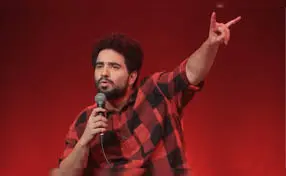
samay raina is now tied to two separate narratives: a public controversy around India’s Got Latent and a personal account of childhood bullying that he says shaped him. In his latest special, he links the emotional damage of one to the memory of the other, making the story about more than a single joke or a single show.
The central question is not whether the backlash was loud. It was. The question is what the backlash revealed: how quickly a comedy controversy can become a larger judgment on people, intent, and responsibility, while the person at the center is also describing a long history of feeling different, targeted, and unwelcome.
What did Samay Raina say about the controversy?
Verified fact: Samay Raina said the backlash over India’s Got Latent affected him deeply. He described the scale of the reaction as “insane” and “disproportionate, ” and said he felt guilty as panel members came under intense criticism. He also said he broke down while recalling the incident.
In the account given during the special, the controversy is tied to a joke involving fellow creator Ranveer Allahbadia. That joke triggered backlash and multiple FIRs against the show’s organisers, including Samay. Following the outrage, all episodes of the show were taken down from YouTube.
Analysis: The important detail is not only that criticism followed, but that the episode became a test of how far public anger could extend. Samay’s phrasing suggests he saw the reaction as far larger than the original moment that set it off. In that sense, the controversy became a case study in how digital outrage can move beyond a clip, a joke, or a single exchange and land on a broader group of people.
Why does his childhood account matter in this story?
Verified fact: In the same special, Samay Raina recalled being bullied after moving from Kashmir to Hyderabad. He said he was beaten up on his very first day at school and struggled to fit in among Telugu classmates who had their own gangs. He added that he was bullied for years, with classmates stealing his snacks, tearing his books, and humiliating him in front of others.
He also said the experience left him with little confidence and made school frightening. One of the most personal details he shared was his discomfort when his father came to pick him up in a Maruti 800. He said he feared ridicule and would ask his father to park away from the school so classmates would not see him.
The language he used goes beyond ordinary schoolyard conflict. He said, “Mere saath racism hua hai…, ” and then defined racism and discrimination as being about who is different and most unlike you. In the context of the special, that line reframes his childhood not as a single episode but as a long period of exclusion.
Analysis: This matters because it complicates the public image of the comedian at the center of a controversy. The same person who is being criticized for a show’s fallout is also presenting himself as someone who has long understood humiliation and social exclusion firsthand. That does not resolve the controversy, but it explains why his response to public criticism appears emotionally charged rather than detached.
Who benefits from the narrative now, and who is under pressure?
Verified fact: The row surrounding India’s Got Latent involved multiple FIRs against the show’s organisers and led to the removal of all episodes from YouTube. Samay said the emotional toll was significant, especially as other panel members faced criticism.
The pressure in this story falls on several levels. Samay Raina is under scrutiny as one of the organisers. Ranveer Allahbadia is part of the original controversy through the joke that triggered the backlash. The panel members are also drawn into the fallout, which Samay said made him feel guilty. That suggests the public response did not stop at one person’s words; it spread across the format itself.
Analysis: What benefits from this cycle is not immediately clear, but the mechanics are familiar: a controversial moment creates attention, then removal, then escalation, then a wider moral debate. In that environment, the original intent of the show matters less than the damage it leaves behind. For Samay, the result is a public identity split between entertainer and target.
What should the public understand about samay raina now?
Verified fact: The special places samay raina’s personal history and the India’s Got Latent backlash in the same emotional frame. He is not speaking only as a comedian defending a show. He is speaking as someone who says he was bullied for years, felt different, and later found himself overwhelmed by the scale of a public backlash.
Analysis: Taken together, the facts point to a deeper contradiction. A performer known for sharp timing is now using a deeply personal set to explain vulnerability, exclusion, and the cost of being publicly condemned. That does not erase the controversy, and it does not answer every question around the show. But it does show why the reaction landed so heavily: for samay raina, humiliation appears to be both a memory and a present-tense experience.
That is why the next demand should be transparency, not noise. The public deserves a clear account of what happened around India’s Got Latent, what responsibilities each person carried, and how the fallout affected those involved. If the debate is to move forward honestly, it must separate verified facts from emotional aftershocks — and it must do so without losing sight of the human cost that samay raina placed at the center of his own story.