The masters par 3 contest produced another sharp reminder that Augusta’s Wednesday tradition is both charming and deceptive: the player who wins it is usually not the one who leaves with the green jacket four days later. In 2026, Aaron Rai finished the nine-hole round at 6-under 21 and won by one stroke, but the broader record remains stubbornly against any direct link between this short-course success and Masters victory.
What is the Par 3 Contest really telling us?
Verified fact: The Par 3 Contest has been part of Masters Wednesday since 1960, when Sam Snead won the inaugural event. Tournament participants and past champions are invited to play the nine-hole course, which sits around DeSoto Springs Pond and Ike’s Pond and was designed by George Cobb and Cliff Roberts.
Verified fact: The event has become a stage for moments that matter beyond the scorecard. In 2025, Colombia’s Nico Echavarria won a playoff over J. J. Spaun after both finished at 5-under-par 22. That same contest produced holes-in-one from Tom Hoge at No. 4, Keegan Bradley at No. 6 and Brooks Koepka at No. 6, taking the all-time total to 115 aces in event history.
Informed analysis: The symbolic weight of the masters par 3 contest comes from its contrast with what follows. A winner can look sharp, relaxed and in form, but the event itself has repeatedly offered little predictive value for the main tournament.
Why does winning the Par 3 Contest seem to hurt rather than help?
Verified fact: In the 63 times the contest has been held in its traditional Wednesday slot ahead of the Masters, no winner has gone on to win the Masters four days later. The historical record is uneven: 21 winners have missed the cut, 10 have finished inside the top 10, and two have ended as runners-up. Raymond Floyd came closest in 1990, losing to Nick Faldo in a playoff.
Verified fact: The last five Par 3 winners have finished 51st, tied for 30th, missed the cut, tied for 50th or missed the cut, and missed the cut. Only two players, Ben Crenshaw and Vijay Singh, have won both the Par 3 Contest and the Masters, but not in the same year. Crenshaw won the Par 3 in 1987 and the Masters in 1995; Singh won the Par 3 in 1994 and the Masters in 2000.
Informed analysis: That record turns the contest into something closer to a caution flag than a forecast. The winner receives attention, but the history suggests the short course can flatter precision without revealing who can sustain it under four full rounds.
Who stood out in 2026, and what did it mean?
Verified fact: Justin Thomas opened the 2026 contest with a birdie at No. 1 and a hole-in-one at No. 2, but by hole 3 his name showed as “WD” on the leaderboard. The record notes that this can happen if a player allows someone else to hit for him, usually a spouse or child. The same event included a wide group of players who did not post a score, among them Scottie Scheffler, Rory McIlroy, Bryson DeChambeau, Ludvig Åberg and Jon Rahm.
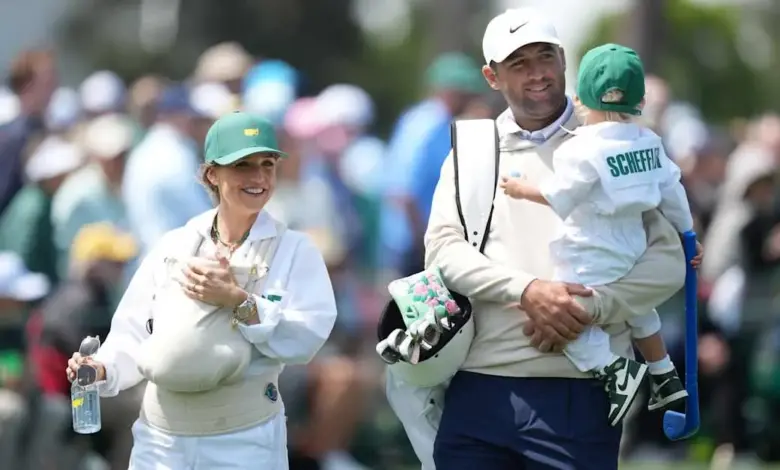
Verified fact: The day also featured family scenes that reinforced the contest’s unusual tone. Scottie Scheffler was shown with his son Bennett, while Meredith held baby Remy. Tommy Fleetwood’s eight-year-old son, Frankie, drew attention for his attempt to clear the water on No. 9, and Gary Player, at 90, rolled in a 30-footer for birdie on the second hole. Player, a three-time Masters champion, still holds the all-time high with six career aces in the Par 3 Contest.
Verified fact: The 2026 round also produced multiple aces. Justin Thomas made one on No. 2, Wyndham Clark made one on No. 7, Keegan Bradley followed with another on No. 8, and Tommy Fleetwood added the fourth ace of the day on No. 4. Bradley’s ace carried added historical weight: he became the first player in Masters history to make a hole-in-one in consecutive years at the Par 3 Contest.
Informed analysis: The list of names explains why the event draws attention. But the scoreboard also shows how quickly the contest can become a memory exercise rather than a competitive signal. A dramatic afternoon does not change the pattern that matters most.
Who benefits from the spectacle, and who is exposed by it?
Verified fact: Aaron Rai, who made his Masters debut a year ago and finished T27, entered 2026 with +20000 odds and won the contest at 6-under 21. That result gave him the official distinction of champion, but it also placed him inside the same long-running historical warning attached to every Par 3 winner.
Verified fact: The strongest names in the field were present, but the contest did not protect them from the usual volatility. The event’s structure, the family participation, and the relaxed setting make it unlike the tournament that begins after it.
Informed analysis: The beneficiaries are obvious: players, patrons and viewers get a rare blend of competition and personal theater. The exposure is equally obvious: anyone trying to read Masters fate from the Par 3 Contest is drawing conclusions from a sample that history has repeatedly undermined. The data is not subtle. The pattern is the message.
That is why the masters par 3 contest remains compelling even when it misleads. It offers a clean piece of evidence, and then immediately warns the public not to overread it. The call for transparency is simple: keep the tradition intact, but keep the record in view. The public should see the contest for what it is — a beloved Wednesday stage, not a prophecy about who will wear the jacket when the week ends.