Masters arrives at a narrow but important turning point: the defending champion begins at 15: 31 ET on Thursday, 9 April, and the field around him already points to a tournament built around form, familiarity and pressure. Rory McIlroy is aiming to become the fourth player to win successive Masters titles, while Scottie Scheffler starts his bid for a third Green Jacket from the late-early side of the draw.
What Happens When the first tee times define the tone?
At Augusta, the opening pairings do more than fill a schedule. They frame the early rhythm of the week, and this year’s Masters draw places several of the tournament’s biggest names in immediate view. McIlroy opens alongside US Amateur champion Mason Howell and last month’s Players winner Cameron Young, a group that keeps the defending champion in familiar tradition while adding two players with distinct momentum of their own.
Scheffler, the world number one and a past champion in 2022 and 2024, begins at 18: 44 ET with Scotland’s Robert MacIntyre and former US Open champion Gary Woodland. That pairing gives the tournament another headline group and underlines the sense that the strongest recent performers are arriving early in the week with very little room for quiet buildup.
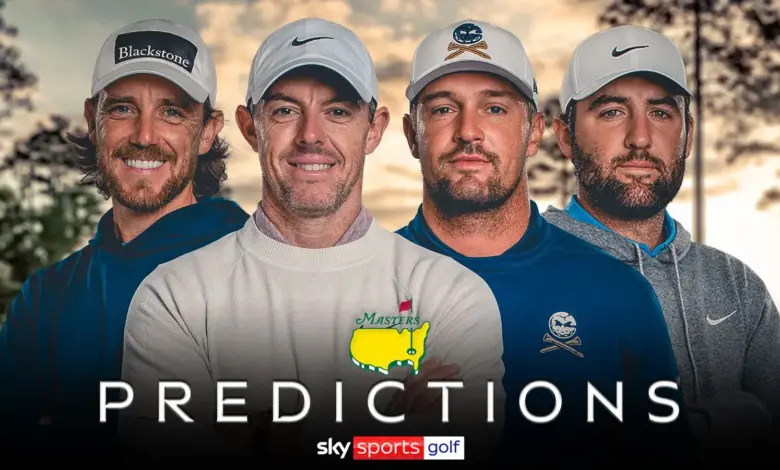
Other notable names are spread through the draw. Matt Fitzpatrick tees off at 15: 07 ET with Bryson DeChambeau and Xander Schauffele, while Tommy Fleetwood starts at 14: 55 ET. Justin Rose, a three-time Augusta runner-up, begins his 21st Masters at 18: 20 ET alongside Jordan Spieth and Brooks Koepka.
What If the contenders separate from the pack quickly?
The current state of play suggests a tournament built around a small group of repeated contenders. Scheffler and McIlroy have won three of the last four Masters between them, and that alone gives the week a clear center of gravity. McIlroy’s last victory ended an 11-year wait for a fifth major title, and his return as defending champion raises the stakes immediately.
Scheffler arrives as the pre-tournament favourite, even after finishing outside the top 10 in his last three PGA Tour starts, his worst run in four years. That contrast is important: the recent results are not ideal, but his broader Augusta record remains strong, with top-20 finishes in every past appearance. The picture is one of proven pedigree versus short-term uncertainty, not a clean break from form.
Rose and Fitzpatrick add another layer. Rose has already won this season and brings established Augusta experience, while Fitzpatrick has also won on the PGA Tour this season and arrives with a fresh result behind him. Tommy Fleetwood, meanwhile, adds depth to the English contingent in a week that marks the 10th anniversary of Danny Willett’s surprise victory and the 30th anniversary of Sir Nick Faldo’s third and final Augusta triumph.
| Player | Current signal | Augusta note |
|---|---|---|
| Rory McIlroy | Defending champion | Seeking back-to-back Masters titles |
| Scottie Scheffler | Pre-tournament favourite | Past champion in 2022 and 2024 |
| Justin Rose | Strong seasonal form | Three-time runner-up at Augusta |
| Matt Fitzpatrick | Recent winner | Part of a marquee grouping |
| Tommy Fleetwood | Leading English contender | Starts at 14: 55 ET |
What If the outsiders force a different Masters outcome?
Any forecast has limits, and the context here is clear: the field contains enough proven winners to make clean predictions risky. Still, the discussion around this Masters is being shaped by three possible paths.
- Best case: McIlroy and Scheffler justify the billing and stay in control, turning the week into a two-player duel at the top.
- Most likely: One of the established challengers, such as Rose or Fitzpatrick, stays close enough to pressure the leaders through the weekend.
- Most challenging: A less expected player breaks through, made possible by the depth of the field and the unpredictability of Augusta competition.
The ceremonial starters, Jack Nicklaus, Gary Player and Tom Watson, also remind the week of its continuity with past champions. That symbolism matters because the event is not just about one round or one pairing; it is about how reputations are tested over four days.
What Happens When the pressure shifts to the contenders?
The winners and losers here will be defined less by reputation alone and more by how the first round frames the rest of the tournament. McIlroy and Scheffler stand to gain the most if they settle quickly into contention, because the pre-tournament attention already sits with them. Rose gains if experience and recent form hold. Fitzpatrick gains if his current numbers translate into patience under pressure.
By contrast, players who need a fast start may lose ground simply because the marquee names are positioned to keep the spotlight. That is especially true in a field where the early tee times are not just logistical detail but part of the story itself. The 90th edition of the first major of the year begins with enough star power to make the first session feel like a preview of the weekend.
What readers should take from this is straightforward: the opening pairings at Augusta are already telling the story of the week, and the balance between proven champions, recent winners and experienced contenders is unusually tight. If the world’s top names hold form, the tournament may follow expectation. If they do not, the structure of this Masters leaves room for a surprise.