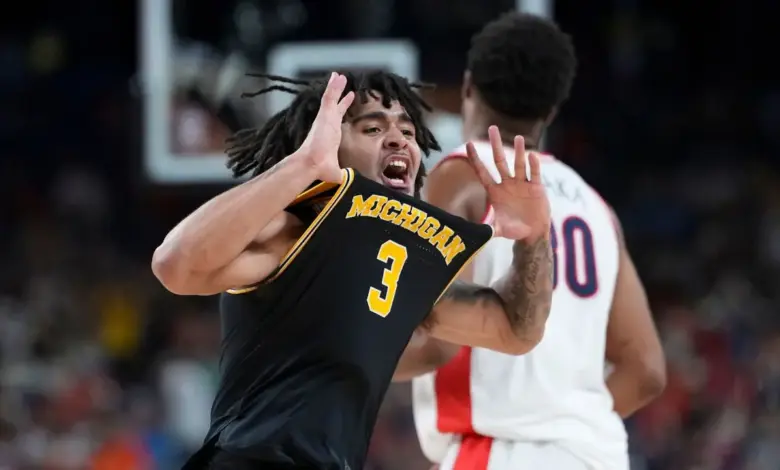
The march madness final is now set, and Michigan enters it with momentum, confidence, and a clear warning sign: the margin for error drops fast from here. After turning a heavily anticipated Final Four matchup with Arizona into a 91-73 rout in Indianapolis, the Wolverines face UConn on Monday night ET with a championship at stake and very little separating the two programs on paper.
Michigan’s latest performance was not just a win; it was a statement about how quickly this team can seize control. The Wolverines became the first team to break 90 points five times in a single tournament and extended their streak of double-digit wins over March Madness opponents to five straight. UConn, meanwhile, arrives after a 71-62 victory over Illinois and will seek its third title in four seasons.
What Happens When Michigan’s pace meets UConn’s title pedigree?
The march madness final brings together two No. 1 seeds that reached this point in different ways but with similar balance. Michigan (36-3) looked overwhelming against Arizona, jumping to a double-digit lead only 5: 31 into the game and finishing with a 48-32 halftime advantage. Arizona entered with elite defensive metrics and top-tier scoring, yet Michigan’s paint protection and pressure around the rim disrupted the Wildcats from the opening minutes.
Junior center Aday Mara powered the Wolverines with a career-high 26 points and nine rebounds. Freshman Trey McKenny added 16 points with four made threes, while Elliot Cadeau produced 13 points and 10 assists. Michigan shot 47. 8 per cent from the floor and 12 for 27 from 3, showing the kind of balance that has carried it through the tournament.
UConn’s path was different but equally convincing. The Huskies defeated Illinois with strong inside play and defense, and they have now won 19 straight NCAA Tournament games in the Sweet 16 or later rounds. That kind of late-round experience is one of the defining forces in the march madness final, especially against a Michigan team that is seeking only its second championship.
What If the injury question changes the matchup?
One of the few concerns for Michigan came when Yaxel Lendeborg rolled his ankle and sprained his knee after landing on an Arizona player’s foot. He still scored 11 points in 14 minutes and returned for the second half, where he hit two quick 3s to push the lead beyond 20. He said he expects to play Monday night ET, and that matters because Michigan has leaned on his presence throughout the tournament.
That injury is the clearest variable in the march madness final. If Lendeborg is close to full strength, Michigan can keep its recent formula intact: pressure defense, rim attacks, and enough shooting to punish mistakes. If he is limited, Michigan will need its depth and shot-making to carry a heavier burden against a UConn team that has already shown it can tighten games and finish them late.
Arizona’s numbers also help explain why Michigan’s performance stood out so sharply. The Wildcats shot 6 for 17 from 3, finished at 36 per cent overall, and managed only two assists against nine turnovers in the first half. Michigan’s approach made Arizona choose between difficult perimeter looks and crowded interior possessions, and the Wildcats never found a sustainable answer.
| Possible outcome | What it would mean |
|---|---|
| Best case | Michigan sustains its early pressure, Lendeborg is effective, and the Wolverines control the pace long enough to secure their second title. |
| Most likely | UConn’s late-round experience keeps the game tight into the second half, turning the march madness final into a possession-by-possession finish. |
| Most challenging | Michigan’s injury uncertainty and a slower offensive start allow UConn to dictate the tempo and reduce the Wolverines’ transition edge. |
Who Wins, Who Loses, and What Should Be Watched Next?
The biggest winners so far are the two programs, both of which have reached the championship stage with strong tournament resumes and high expectations intact. Michigan has validated its season with a dominant run, while UConn has reinforced its reputation as a team that knows how to survive and advance in late rounds. Their coaches also stand at the center of the next step: Dusty May has guided Michigan into a title game, while Dan Hurley has his team chasing another trophy.
The clearest losers are the teams that hoped to exploit a possible mismatch in the bracket. Arizona, despite entering with elite credentials, was overwhelmed early and never recovered. Illinois also fell short against a UConn team that once again controlled key moments. In a short tournament, those gaps are decisive.
For readers, the key lesson is straightforward: the march madness final is not just a matchup of records or reputations, but a test of whether Michigan’s current surge can hold up against a UConn program built for this stage. The safest forecast is a close game shaped by execution, rebounding, and injury management rather than raw talent alone. Watch the opening minutes, watch Lendeborg’s mobility, and watch whether Michigan can reproduce the same pressure it used to flatten Arizona. That is where the final may be decided in Eastern Time.
In a tournament defined by momentum, Michigan has arrived at the right moment. Now the march madness final will show whether that momentum is enough.