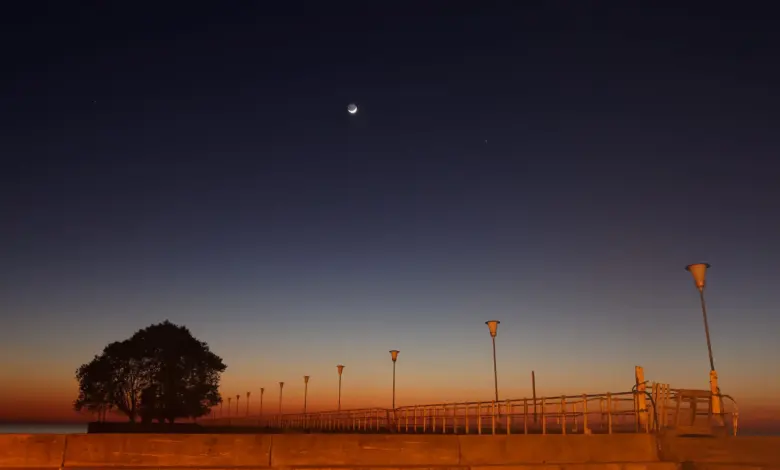
The full moon april 2026 is the April Pink Moon, reaching its peak at 03: 12 BST on Thursday 2 April. The full moon april 2026 carries a mix of seasonal names and practical impacts — it ties into the timing of spring observances and shares the April sky with notable planetary displays.
What Happens When the Full Moon April 2026 Peaks?
The April full Moon is traditionally called the Pink Moon not because of its color but because it marks the bloom of pink phlox across North America. When the Moon rises low on the horizon it is more likely to look orange than pink: sunlight reflected from the lunar surface passes through a denser layer of Earth’s atmosphere, which scatters blue and violet light and leaves the redder hues.
The April full Moon also plays an astronomical role in setting the date of Easter and Passover: Easter falls on the first Sunday after the first full Moon that follows the spring equinox. Alternate traditional names for this full Moon include the Sprouting Grass Moon, Egg Moon, Fish Moon and Breaking Ice Moon, reflecting seasonal events. Seasonal names more broadly — such as Hunter, Harvest and Flower Moons — were used historically to mark changing seasons.
What If You’re in the Southern Hemisphere?
April evenings offer views of the two brightest planets, though only one dominates at night. Jupiter gleams at magnitude –2. 1 and dominates the northern sky as twilight fades, lying in Gemini near the star Pollux. In the Southern Hemisphere Jupiter sits fairly low because it lies well north of the celestial equator; it nonetheless presents a compelling telescopic target, spanning about 37″ at midmonth and showing atmospheric detail and its four bright moons during moments of steady seeing.
Venus, brighter at magnitude –3. 9 (roughly five times brighter than Jupiter), is less prominent after sunset because it sets during twilight. Look low in the northwest about 45 minutes after sunset, with visibility improving late in the month; on April 30 Venus’s disk measures about 12″ and appears nearly 90 percent lit.
Predawn in April brings a compact trio of Mercury, Mars and Saturn during the month’s second half. Mercury reaches greatest elongation on April 3, lying about 28° west of the Sun and standing roughly 15° high an hour before sunrise; on that date Mercury appears magnitude 0. 3 with an 8″ disk about half-lit. Mars starts the month roughly 10° below Mercury with a magnitude near 1. 2 and reaches close conjunction with Mercury on April 20, separated by about 1. 8°. Saturn, at magnitude 0. 9, passes near both on April 20 but remains low and therefore is limited for detailed telescopic viewing.
What to Expect for Viewing — Timing, Weather and Upcoming Events
- Peak time: Full Pink Moon peaks at 03: 12 BST on Thursday 2 April.
- Appearance: Low on the horizon the Moon often appears orange due to atmospheric scattering.
- Seasonal names: Pink Moon, Sprouting Grass Moon, Egg Moon, Fish Moon, Breaking Ice Moon; historically used to mark seasonal events.
- Sky context: Jupiter and Venus dominate evening views; Mercury, Mars and Saturn gather in the predawn sky mid- to late-month.
- Special event: A waxing gibbous Moon occults the 1st-magnitude star Regulus in Leo on April 26; eastern South America offers the best viewing locations, with specific disappearance and reappearance times noted for Vitoria, Brazil.
Viewing conditions will vary regionally. Forecasts for the night around the full Moon indicate mixed prospects: many areas should see clear spells and favourable viewing at times, while southern and south‑east England are likely to have more cloud during the first half of the night before conditions improve as cloud and patchy rain clear south‑eastwards. By dawn, cloud is expected to build across Northern Ireland. Lighter evenings do not substantially reduce the Moon’s impact when skies are otherwise clear.
Practical takeaway: plan for a window after moonrise when the horizon glow can produce dramatic color, check local forecasts for cloud and patchy rain, and note that the April Moon anchors the calendar for spring observances. Observers in the Southern Hemisphere should also factor in the month’s notable planetary shows in both evening and predawn skies as complementary targets to the full Moon. Keep these timings and conditions in mind as you watch the full moon april 2026.