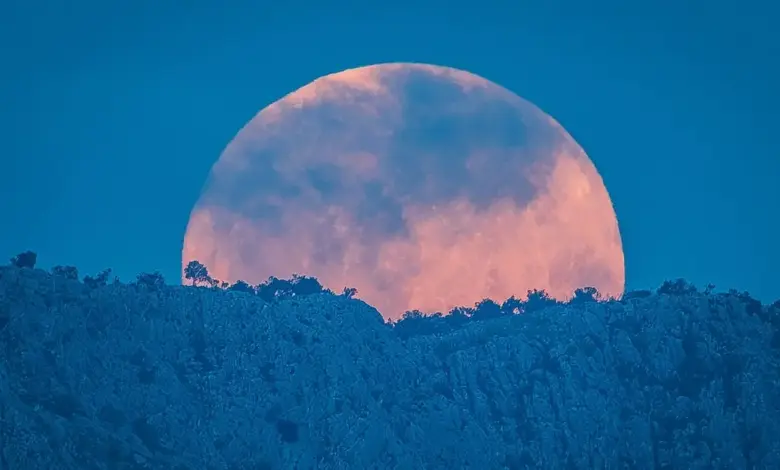
The spring sky opens with the pink moon 2026, an early April full moon whose timing and local rise promise dramatic horizon views. The moon reaches full in the evening hours, and its appearance will be framed by a busy month of skywatching: a potentially bright sun‑grazing comet, a compact planet parade before dawn, and several notable alignments that together make April one of the year’s most active stargazing windows.
Pink Moon 2026: Timing and Local Views
The pink moon 2026 is set to be full on April 1, with the lunar disk reaching peak fullness late that evening. The moon will be notably bright and large as it rises above the eastern horizon at sunset; one timing reference places the moment of fullness at 10: 12 p. m. ET on April 1, while another cites 10: 13 p. m. EDT the same night. Observers are advised to look to the east at moonrise for the most dramatic contrast as dusk fades.
The name carries regional and seasonal meaning: the term “pink moon” is linked to early spring wildflower blooms in eastern North America, and in some traditions the month’s full moon is called the paschal moon because of its role in determining Easter. The pink moon 2026 is also one of 13 full moons expected this year, a cadence produced when the lunar year outpaces the solar calendar.
Background & Connected April Sky Events
April’s nocturnal lineup extends well beyond the full moon. Early in the month, observers can attempt to spot Mercury as it reaches greatest western elongation on April 3, making a brief pre‑dawn appearance above the east horizon; Mars will follow soon after Mercury rises. A potentially significant comet, Comet C/2026 A1 (MAPS), will reach its closest point to the sun around April 4 and is described as a sun‑grazing object that will pass within roughly 850, 000 miles of the sun. That perihelion passage could either destroy the comet or spark a vivid display; if it survives, southern observers are likelier to see a striking apparition, while northern views are expected to be fleeting and low on the horizon.
Mid‑April brings an exceptional planet parade: between about April 16 and 23, Mercury, Mars and Saturn will form a tight cluster just above the eastern horizon for roughly a half hour before sunrise. The most compact configurations are expected between April 18 and 20. Other highlights include enhanced visibility of the Milky Way’s core around the new moon near April 17 and, after sunset on April 18 and 19, a loose lineup of the crescent moon, Venus and the Pleiades above the western horizon.
Analysis and Institutional Notes
Taken together, these events create several observational opportunities and a few practical constraints. The pink moon 2026 will be most dramatic at moonrise, when lunar brightness combines with horizon perspective to amplify apparent size. That same lunar brightness can suppress fainter targets on evenings close to the full phase; conversely, the new moon around April 17 opens a window for deep‑sky views such as the Milky Way core.
The calendrical role of the April full moon also has broader cultural consequence: as a paschal moon it is the ecclesiastical marker used in Western Christian tradition to fix the date of Easter. The spring equinox this year is noted as March 20, with the church’s fixed equinox date of March 21 affecting how the paschal calculation is applied; this cycle results in Easter falling shortly after the April full moon.
Operationally, a handful of April events will demand horizon‑clear sightlines. The planet parade and Mercury’s greatest elongation require unobstructed eastern horizons—lakeshores and flat, open fields are cited as ideal viewpoints—while any potential cometary show could be brief and concentrated near the horizon, improving markedly for southern observers if the object survives perihelion.
Fact and analysis are distinct here: the calendar times and event windows are fixed observational details, while the likely visibility of transient objects such as Comet C/2026 A1 (MAPS) remains uncertain until after its close solar passage. What is certain is that April’s sequence—from the pink moon 2026 to the mid‑month planet alignment—offers at least eight noteworthy reasons to look up this month.
How will photographers, amateur astronomers and religious calendars together interpret the month’s crescendo of lunar, planetary and cometary events—and which evenings will become the season’s most photographed? The answers will unfold across April’s changing skies.