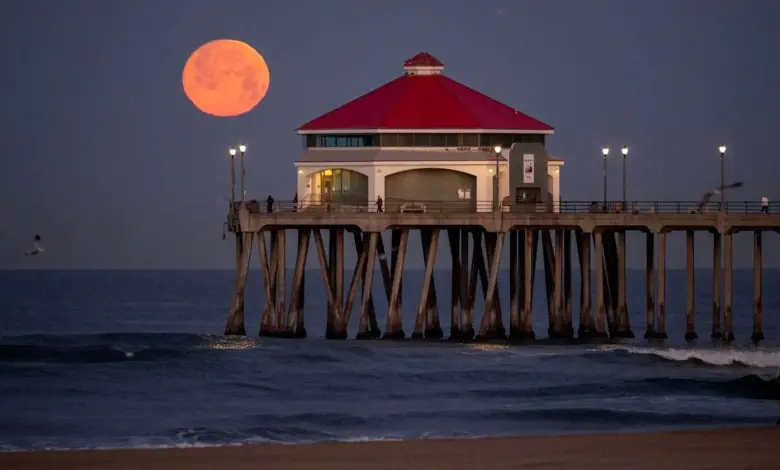
One calendar anomaly — 13 full moons in 2026 — frames a striking sequence: the full moon march coincided with a blood moon total lunar eclipse, while April’s Pink Moon will peak at a time that determines Easter this year. This interplay of lunar events exposes how astronomical timing and calendar traditions can collide.
Full Moon March: What happened in March?
Verified facts: The sequence of 13 full moons in 2026 included a “blood moon” total lunar eclipse in March. That March eclipse is part of the yearlong pattern that also produces the April Pink Moon and subsequent notable lunar events.
What is not being told? Public summaries of the year’s lunar sequence list the March total lunar eclipse as a high-significance event, but the overlap of a dramatic March eclipse with the calendar’s spring timing receives little explanation when those same calendars turn immediately to April’s Pink Moon and its role in setting religious observances.
How does the April Pink Moon decide the calendar — and when will it appear?
Verified facts: April’s full Pink Moon is the fourth of the 13 full moons in 2026. The moon will reach its fullest point on April 1, with official times listed at 10: 13 p. m. EDT and 7: 13 p. m. PDT; an alternate listing shows 10: 12 p. m. ET. The pink name references pink phlox wildflowers that bloom in eastern North America. On the day after the full moon, the lunar disk will appear less than two degrees from the bright star Spica.
Why this matters: April’s full moon also functions as the paschal moon — the decisive lunar marker for determining Easter. The spring equinox occurred on March 20 this year, while liturgical practice uses a fixed ecclesiastical date of March 21; the first full moon after that point sets the earliest possible Sunday for Easter. For this sequence, Easter must fall on April 5.
Practical viewing notes: The Pink Moon rises during dusk and looks most dramatic when it first appears above the eastern horizon. Observers are advised to seek elevated, open, east-facing locations for an unobstructed horizon. On the West Coast a rare alignment is noted where the moment of full moon, sunset, and moonrise converge at the same local time.
What does the juxtaposition of the March eclipse and April Pink Moon mean for observers and the calendar?
Evidence summary (escalating): 1) The year contains 13 full moons, an unusual count tied to the mismatch between the solar and lunar years. 2) A March total lunar eclipse produced a blood moon within that set. 3) The April Pink Moon is timed to peak at specific clock times and then to appear near Spica the following night. 4) That April full moon is the determining paschal moon that fixes Easter’s date this cycle.
Analysis: Viewed together, these facts show a tension between astronomical precision and calendar convention. A dramatic event in March alters the public’s expectation of lunar drama, yet the April full moon — timed by the clock and by ecclesiastical rules tied to the equinox — is the secular and religious hinge. Slight variations in published peak times highlight how small timing differences can change liturgical outcomes or public celebration dates.
Accountability and forward look: Verified scheduling information and clear guidance on horizon-dependent viewing conditions are essential for the public, faith communities, and observatories planning events. Transparency in published lunar timing, plain explanations of how the paschal moon is applied to determine Easter, and clear local moonrise forecasts will reduce confusion between high-profile lunar spectacles such as the March blood moon and the April Pink Moon. Observers should note the sequence that links the full moon march event and the April Pink Moon when planning viewing or community observances; the full moon march remains a key part of the year’s lunar story.