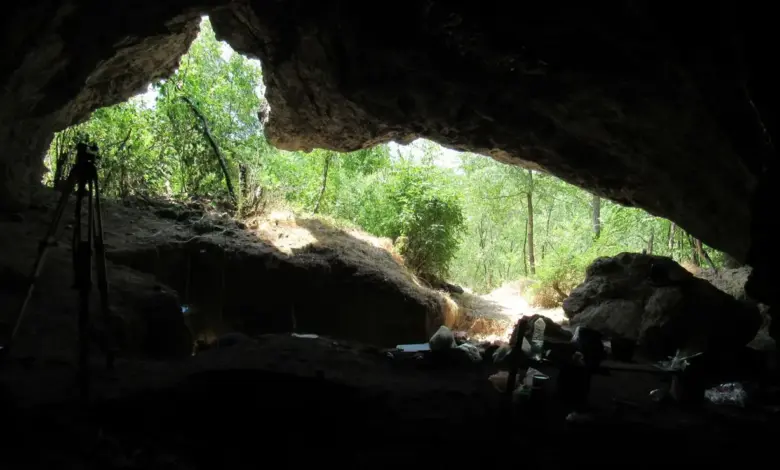
In a damp cave where chalk and shadow meet, fragments of bone have become a ledger of survival: neanderthals in Europe underwent a dramatic genetic turnover, leaving behind a single maternal lineage that later spread across the continent. That scene — a handful of fossils and the genomes they hold — now frames a larger, unsettling story about isolation, climate and the fragility of small populations.
What did the new DNA analyses find about neanderthals?
Researchers combined 10 newly recovered mitochondrial genomes from sites in Belgium, France, Germany and Serbia with 49 previously sequenced mitochondrial genomes to trace maternal lines. The analysis, published March 23 in the journal PNAS, shows that Neanderthals who lived between about 60, 000 and 40, 000 years ago largely belonged to a single mitochondrial lineage that appears to have arisen around 65, 000 years ago. Earlier mitochondrial lineages that once existed were absent in these later individuals, a pattern the researchers describe as a clear population turnover.
Complementing the mitochondrial work, a separate high-coverage nuclear genome from a Neanderthal called D17 — sequenced from a small bone fragment recovered in Denisova Cave and led by teams at the Max Planck Institute for Evolutionary Anthropology and Yale University — paints a picture of small, highly related groups. In D17’s genome about 1. 2 heterozygous positions occurred per 10, 000 nucleotides, lower than some other Neanderthals and much lower than early modern humans. Large stretches of identical chromosomes, the result of close kin mating, covered roughly 24% of D17’s genome; comparable figures for other Neanderthals ranged from 14% to 24%, while a Denisovan from the same cave showed only 4% and early modern humans between 1% and 6%.
What does this mean for Neanderthals’ history?
The genetic evidence links a climatic contraction and long-term demographic decline. Cosimo Posth, a researcher at the University of Tübingen in Germany, says, “There must have been a population turnover towards the end of the Neanderthal history. ” Posth points to a major glaciation beginning around 75, 000 years ago as a trigger that concentrated populations into refuges — notably a dense cluster of archaeological sites in south-west France. From that refuge, the single surviving lineage later expanded when conditions warmed, reaching as far east as the Caucasus without showing a clear rebound in overall population size.
Genomes from different regions also reveal that Neanderthal groups were more isolated from one another than any comparable groups of modern humans, and that eastern Neanderthals in the Altai region lived in especially small groups. Demographic models based on homozygosity suggest some eastern groups numbered fewer than 50 individuals, a scale that makes populations vulnerable to loss of genetic diversity and stochastic events.
Who is acting, and what do the scientists say?
Teams sequencing both mitochondrial and nuclear genomes are the primary actors in this unfolding reconstruction. The PNAS study assembled mitochondrial data across multiple European sites; the high-quality D17 genome came from careful recovery and sequencing of a tiny bone fragment identified through paleoproteomic techniques. Those laboratory efforts have produced the empirical evidence linking climate, geographic contraction and genetic bottlenecks.
Posth underscores the power and limits of the data: while the broad pattern points to a contraction and subsequent spread of a single lineage, not every specimen fits neatly. One individual, known as Thorin from Grotte Mandrin in France, dates to a later time yet carries one of the older mitochondrial lineages. Posth calls Thorin “the only specimen that doesn’t fit into the story, ” an outlier that keeps the end of the Neanderthal narrative unresolved.
These genetic projects do more than name patterns: they quantify how little diversity remained and how often close relatives mated, revealing demographic stresses that geneticists and archaeologists must now link to material culture and climate records.
Back in that cave where bone fragments lie like timestamps, the story is both clearer and more puzzling. The DNA shows a lineage that survived an ice age and then spread; the presence of Thorin and the persistence of small, isolated groups remind us that extinction is rarely a single cause. The ledger in the rock closes on many entries but leaves an open line — why did one lineage survive when others vanished, and what did that mean for the final chapters of Neanderthal existence?