canada faces a constitutional inflection as the Supreme Court begins a four-day hearing on Quebec’s Bill 21, a law that prohibits certain public sector workers from wearing visible religious symbols at work.
What Happens When Canada’s Top Court Confronts Bill 21?
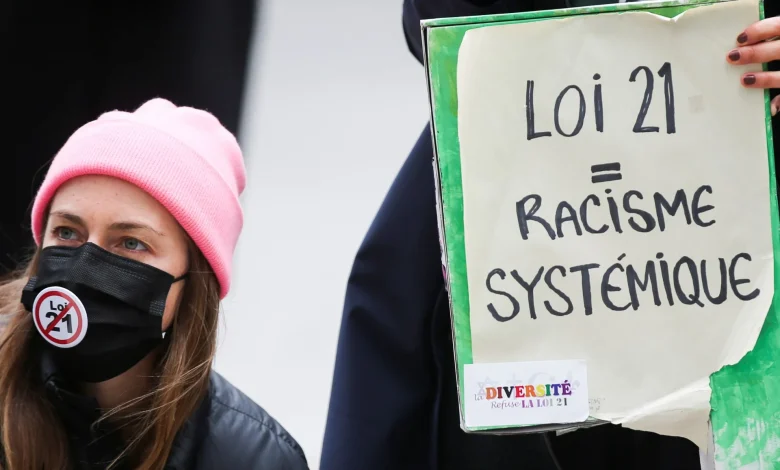
The hearing is one of the most consequential constitutional cases in recent memory. Bill 21 bars many public sector employees — including teachers, prosecutors, police officers, and judges — from wearing visible religious symbols such as hijabs, turbans and kippahs while at work. The National Council of Canadian Muslims and the Canadian Civil Liberties Association launched the constitutional challenge. Evidence before the court shows the law affects people of many faiths, and it falls particularly heavily on Muslim women who wear the hijab, for whom teaching and other public service careers have effectively been closed off.
What If the Notwithstanding Clause Remains Unchecked?
At the centre of the case is the province’s use of the notwithstanding clause, a constitutional mechanism that allows governments to override certain Charter protections. No other constitutional democracy in the world has a similar blanket override of fundamental rights and freedoms. The clause was embedded in the constitutional framework in the early 1980s as part of the Kitchen Accord. Prime minister Pierre Trudeau accepted the compromise as part of a broader effort to secure consensus. Federal justice minister Jean Chrétien argued at the time that the clause would be politically difficult for future governments to wield. That presumption has frayed: in recent years provinces have invoked the clause more readily, and Quebec used it to shield Bill 21 from some legal challenges. The case will therefore test whether constitutional rights remain meaningful constraints on government power or can be suspended when politically convenient.
What Are the Possible Futures for Rights, Diversity and Public Service?
- Best case: The court strikes down or narrows the application of Bill 21, restoring access to public employment for visibly religious people and reinforcing Charter protections against policies that exclude on the basis of faith.
- Most likely: The court issues a nuanced ruling that preserves aspects of the law while clarifying limits on the pre-emptive use of the notwithstanding clause, leaving significant debate over enforcement and recruitment in public institutions.
- Most challenging: The court upholds the law without major constraint on the clause, normalizing broader provincial power to override rights and intensifying tensions over national unity and the balance between courts and elected officials.
Christine Van Geyn, executive director at the Canadian Constitution Foundation, described the case as “probably going to be the most important constitutional case in a generation. ” The stakes are both individual and institutional: they include questions of religious freedom and equality, the message sent to young people about participation in public life, and whether elected governments or courts hold the decisive check on rights.
What should readers take away and watch for? Follow the court’s reasoning on the interaction between Bill 21 and the notwithstanding clause, note how evidence about the law’s impact on different faith communities is weighed, and observe whether the judgment narrows or broadens the political space for future override legislation. Civil rights groups and those affected will continue to press the arguments brought to the Supreme Court, and the decision will shape how public institutions approach neutrality, diversity and inclusion.
Expect uncertainty in the short term, but recognize that the ruling will be a defining signal about the resilience of Charter protections and the contours of state neutrality — and about the kind of canada