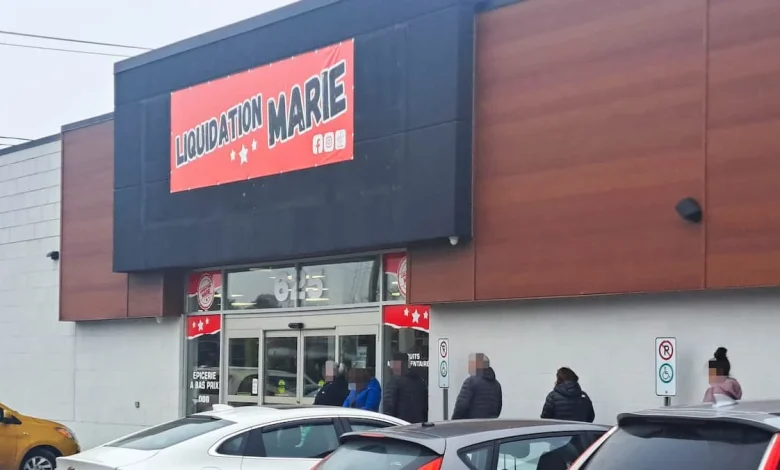
The épicerie liquidation marie model has exploded in popularity, drawing several hundreds of shoppers daily to a Longueuil location and turning nearby residential streets into de facto parking lots. What began as a low-cost recovery grocery has produced mounting neighbourhood tensions and a test of municipal tools for managing rapid retail growth.
How has Épicerie Liquidation Marie created unexpected neighbourhood strain?
Verified facts: Sylvain Charlebois, specialist in the agri-food industry, describes the enterprise as operating on a recovery model that resells surplus inventory rejected by major chains and calls this a form of upstream food rescue. The company has grown quickly — the business now employs more than 700 people and has opened a dozen stores with another location announced for Sorel. The Longueuil outlet opened in October and provides roughly ten on-site parking spaces while attracting several hundreds of customers daily. That imbalance has produced long street parking queues and spillover into adjacent private driveways.
Who is accountable: the retailer, the city, or visiting customers?
Verified facts: Residents on Rue Brault and nearby streets report repeated incidents of private driveways being blocked, confrontations between neighbours and customers, and near-miss traffic incidents. Individual neighbours named in the neighbourhood account — Haru Liu, Danielle Fortier, Daniel Forest and Sophie Campagna — have taken measures such as buying personalized signs or installing barriers to protect access to their properties. The Service de police de l’agglomération de Longueuil (SPAL) increased patrols and a police spokesperson, Raphaël Larocque-Cyr, noted that the store complies with the city’s urban planning regulations, which limits municipal leverage to restrict the store’s activity or its customer volume. City actions have nonetheless included a change to local signage on February 3 and enforcement agents issued 370 parking infractions on Rue Brault since the store opened.
Statements from the business owners, Christian Bélanger and Marie-Ève Breton, acknowledge that the Longueuil location proved more popular than anticipated; Breton said that, in hindsight, a different site might have been preferable. Breton has also said the store has adjusted signage and is urging customers to park legally and behave civilly.
What are the verified facts and what do they imply for public oversight?
- Business model: The retailer uses surplus recovery to supply discounted goods, a approach described by Sylvain Charlebois as distinct from typical grocery chains.
- Scale and footprint: The operation now exceeds 700 employees and 12 open locations, with ongoing expansion.
- Local impact: The Longueuil store opened in October, offers about ten parking spaces, attracts several hundreds of shoppers daily, and prompted 370 parking tickets on one adjacent street.
- Municipal stance: The Service de police de l’agglomération de Longueuil confirms stepped-up enforcement, and the Ville de Longueuil modified street signage; city officials indicate the store conforms with urbanism rules.
Analysis (clearly labeled): Viewed together, these facts point to a structural mismatch between a high‑volume discount retail model and the existing street-level infrastructure in a dense urban corridor. The retailer’s recovery-based inventory and aggressive price proposition explain customer surge; limited on-site parking and fast-moving bargain-driven behaviour explain spillover into residential areas. Municipal tools have been used — signage changes and enforcement — but the store’s conformity with planning rules constrains short-term regulatory options. The risks observed include continued neighbour friction, enforcement fatigue among parking officers, and pressure on local policing resources.
Accountability call (verified and evidence-based): Local governments should publish a clear enforcement and mitigation plan that identifies short-, medium- and long-term measures tied to named agencies and measurable targets. The store operators and municipal authorities should jointly communicate specific temporary measures for the Longueuil site — including expanded lawful parking capacity, coordinated signage, scheduled crowd management for high-volume announcements, and a timeline for evaluating impacts. Residents deserve regular public updates from the Ville de Longueuil and the Service de police de l’agglomération de Longueuil on enforcement outcomes and any regulatory steps under consideration.
Final note: The tensions surrounding the épicerie liquidation marie outlet in Longueuil reveal a recurring policy challenge — rapid retail innovation can outpace neighborhood infrastructure — and demand transparent cooperation among the retailer, policing authorities and city hall to restore coexistence while preserving consumer access to low-cost food.