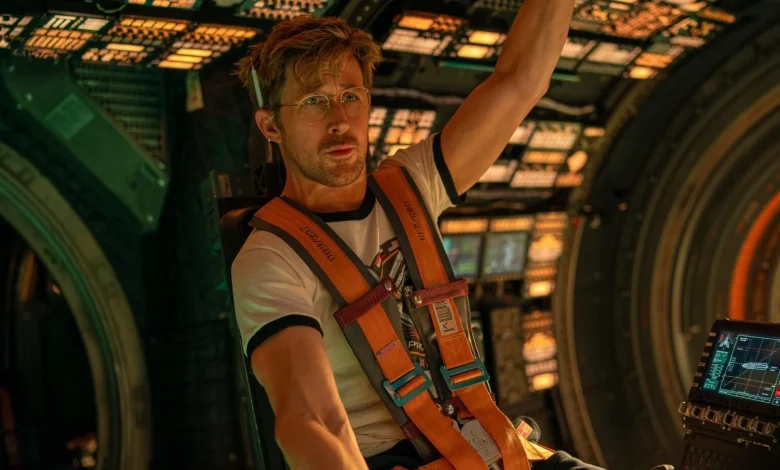
In a dim, humming set meant to stand in for the endless dark, Ryan Gosling sits strapped to a narrow mockup of a spacecraft, an earwig in his ear and the directors’ voices fed to him through a microphone. This is the first image the hail mary movie asks you to hold: a single man, alone inside an impossibly expensive machine, carrying the weight of an entire planet on his shoulders.
What the Hail Mary Movie wants from its audience
That solitary image mirrors the film’s larger ambition. The picture positions Ryan Gosling as Dr. Ryland Grace, a high school teacher-turned-astronaut launched on a world-saving mission. It is an intentionally big, Spielbergian crowd-pleaser: elaborate, expansive and crafted to revive the theatrical spectacle. Yet the directors’ desire to get serious bumps up against their congenital goofiness, producing a film that oscillates between wrenching human stakes and engineered crowd-pleasing mechanics. The movie adapts an Andy Weir novel into a 156-minute feature and assembles a cast that includes Sandra Hüller and Ken Leung, with a screenplay by Drew Goddard and direction by Phil Lord and Chris Miller.
On set: solitude, science and unexpected partnerships
Gosling’s performance was forged in long stretches of solitude. “A lot of times I’d be locked into the set for hours on end with an earwig, ” Ryan Gosling, actor, said of the process. He described a working method where the directors spoke to him through a mic, allowing experimentation and small adjustments to keep the film from being overwhelmed by its scale. The production staged scientific work with support: molecular biologists were present for experiments, and astronauts advised the cast and crew. Andy Weir, author, sent Gosling an unpublished manuscript and encouraged him not only to play the lead but to take on a shaping role in the project as a producer, deepening the actor’s investment in the story.
Can spectacle carry a human story?
The film asks whether a quarter‑billion‑dollar mission can still feel like an honest tribute to human resilience. On one hand, the screenplay frames Dr. Grace as an Everyman: intelligent, untrained in survival, and forced into heroism by circumstance. On the other hand, the production’s deliberate embrace of comedy and whimsy—traits associated with Phil Lord and Chris Miller—pulls the tone toward levity at moments intended to be solemn. That tension is central to the viewing experience: you are invited to laugh, to cry, and to believe that Gosling’s character can float through impossible odds, even as the movie sometimes substitutes engineering for emotional subtlety.
Voices on the project extend beyond the cast. Drew Goddard, screenwriter, translated the novel’s structure for the screen; Phil Lord and Chris Miller, directors, retooled familiar genre textures into a film that seeks both spectacle and heart. Ken Leung appears in a supporting role that punctuates the mission’s human networks, while Sandra Hüller inhabits the governmental side of the story as an official who recruits the protagonist for the perilous assignment. The presence of scientific advisors and astronauts on set reflects an intention to root the film’s technical moments in lived expertise even as the narrative pursues emotional universality.
What, then, does the production do with that expertise? It uses it to craft moments that feel credible amid the physics of a space-set drama, but it also packages those moments inside a movie that is overtly designed to be a crowd-pleaser. The result is effective on its own stated terms: funny, absorbing and familiar without being derivative, yet sometimes grinding where it means to be graceful.
Back on the darkened mockup, the same man who began the film’s first scene now bears the full meaning of the mission. The earwig still feeds directions, but the actor’s solitude has been transmuted into a performance shaped by writers, directors, scientists and an author who urged him onto the project. In that way, the hail mary movie becomes an allegory of its own making: an elaborate, expensive bid to convince audiences that the theater still matters, and that a single human face can carry the weight of a global story.
Whether that bet pays off depends on what you ask of spectacle and what you look for in human truth. The spacecraft set remains lit and humming, an engineered universe that, for a time at least, asks us to sit together in the dark and believe.