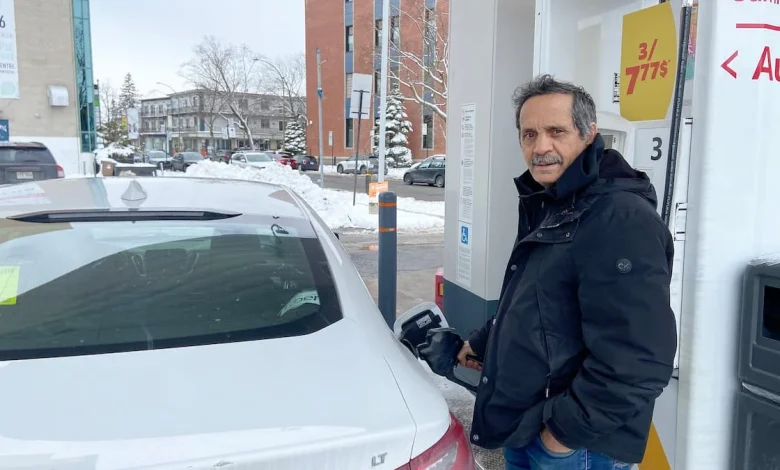
At a Saint-Michel service station a man fills his tank while watching the numbers climb on the dispenser — 188. 9 cents per litre on the screen. The scene captures the sudden, sharp pain many feel over the province’s prix essence problem: Bouzid Essakhi, an Uber driver in Montreal, said, “It represents a 25 to 30% drop in my income. I have to work more and cut my expenses. ” He added, “Trump is doing foolish things and I suffer the consequences. “
Prix Essence: Why are prices rising so quickly?
The immediate trigger described by energy specialists is a disruption in Middle East oil flows. Yvan Cliche, specialist in energy at the Centre d’études et de recherches internationales de l’Université de Montréal, said the market faces « the worst nightmare lived by the oil market in years » with a physical interruption he quantified as 20 million barrels per day. He also noted that, in Quebec, roughly 25% of oil is imported from outside Canada and mainly comes from the North American market — a factor that leaves provincial pump prices exposed when global supplies tighten.
Retail prices have reflected that shock. In some Montreal-area stations the price reached 184. 9 cents per litre; a platform compiling local station prices showed an average around 178. 7 cents per litre in the province on a recent afternoon. At one downtown corner station the pump read 183. 9 cents per litre. Nicolas Ryan, director of public affairs at CAA Québec, explained how prices can vary across regions: stations are free to set their own prices, and certain taxes differ from one area to another.
How are people coping with rising pump prices and related costs?
Drivers who depend on their cars for work express stark choices. Omar Seqqal, a delivery driver in Montreal, sighed, “This is hot, but I’m a delivery driver, so I have no choice. ” Stan Michel, a father who works on the South Shore, said he was shocked by the cost but that public transit would be too slow for his commute. Sophie Victor, a resident of Quebec City, summed up the pressure at the household level: “It adds an expense and puts pressure on budgets. “
Retail behaviour has shifted subtly: the attendant Wassim at one service station observed that people continue to visit but “they buy less fuel each time. ” The price shock is not limited to transportation fuels. Martin Caron, president general of the Union des producteurs agricoles, warned that the same disruptions are hitting nitrogen fertilizers. He explained that before 2022, fertilizer supplies came from Russia and that Gulf countries were the fallback; the Strait of Hormuz blockage has pushed fertilizer prices up by 10 to 20%, adding strain to food production costs.
What responses are being proposed and who is acting?
At the international and federal level, measures have been described to stabilize markets. The AIE released a plan to put a large volume of strategic stocks into the market; it would make 400 million barrels available from reserves, its largest release in history. Canada committed 23. 6 million barrels to a broader plan linked to that effort, and Tim Hodgson, Minister of Natural Resources, stated that Canada would “do its part” to help reduce global oil prices.
Closer to home, experts and policy voices warned against short-term, populist fixes that could undermine long-term funding. A public policy analysis noted that cutting fuel taxes or registration fees would reduce revenues dedicated to road maintenance and public transit; the fuel tax was identified in the debate as 20. 2 cents per litre and the vehicle registration fee as $140. The same analysis pointed out a cumulative infrastructure maintenance deficit of $22. 5 billion, and proposed an alternative: dedicate part of the Fonds d’électrification et de changements climatiques (FECC) revenues to targeted rebates for low-income households or residents in regions without transit services, preserving core funding while easing pressure on those most affected.
Meanwhile, businesses and individuals navigate immediate choices: drive less where possible, reduce fill-ups, or absorb the added cost. Éric Aubin, filling up nearby, said he hoped the spike would push more people toward public transit; local workers like Bouzid Essakhi must decide between longer hours and shrinking margins.
Back at the pump in Saint-Michel the numbers keep flashing. Bouzid Essakhi finishes his fill-up, the beat of the city’s traffic in the background — and the province’s prix essence challenge remains unresolved, balancing short-term relief against long-term budgets and supply realities.