Mars: Curiosity Cracked Open a Rock and Revealed a Huge Surprise — A New Twist in the Search for Life

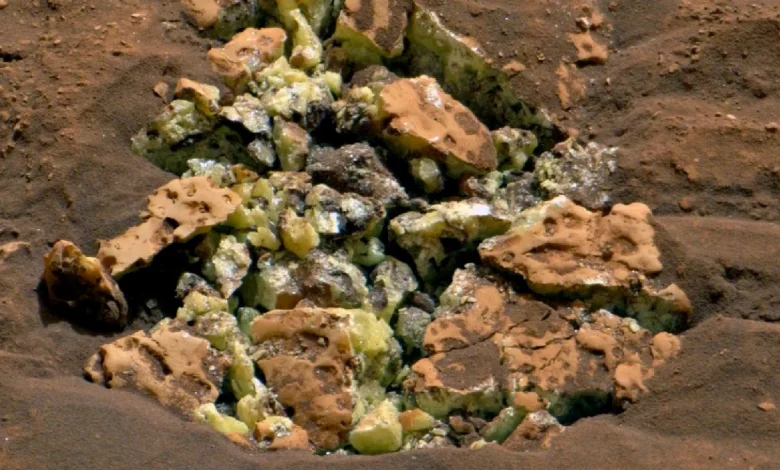
Dust rose in a narrow channel as the rover’s wheels passed over a nondescript lump and, by chance, cracked it open; what spilled out was not red dust but bright yellow crystals. The Curiosity rover rolled its 899-kilogram (1, 982-pound) body over the fragile mineral in May 2024 and exposed elemental sulfur, a discovery that reframes how scientists think about the ground they are studying on mars.
What Curiosity found on Mars
The cracked stone, uncovered in the Gediz Vallis Channel, revealed yellow crystals of elemental sulfur — brimstone — not the sulfates scientists more commonly find. Curiosity project scientist Ashwin Vasavada of NASA’s Jet Propulsion Laboratory said, “Finding a field of stones made of pure sulfur is like finding an oasis in the desert. ” The rover’s instruments identified the material, and observers noted that the channel is littered with objects that resemble the cracked stone, suggesting elemental sulfur may be abundant in places there.
How the sulfur links to hidden water and hardened dunes
Separate work led by Dimitra Atri, Principal Investigator of New York University Abu Dhabi’s Space Exploration Laboratory, examined ancient sand dunes in Gale Crater and found evidence that groundwater moved beneath the surface and slowly hardened dunes into rock. That research named minerals such as gypsum as markers of moisture moving upward through sand and leaving preservable deposits. Atri said, “Our findings show that Mars didn’t simply go from wet to dry. ” The NYU Abu Dhabi team, which included research assistant Vignesh Krishnamoorthy and collaborators such as James Weston of NYUAD’s Core Technology Platform and members of Panče Naumov’s research group, linked subsurface water activity to environments that could preserve organic traces.
Both strands of discovery — elemental sulfur on the surface and groundwater-altered dunes beneath — point to a more complex environmental history. Sulfates form when sulfur in compound form mixes with minerals in water and then dries; by contrast, pure sulfur forms only under narrow conditions that are not known to have occurred in the region where Curiosity found it. Scientists now face the question of how elemental sulfur and signs of past subsurface water coexist in the same landscape.
What scientists are doing and what comes next
Teams are planning careful follow-up work. Curiosity’s unexpected routing provided an accidental exposure that instruments could analyze immediately; researchers said the next step is to explain how, within the constraints of what is known about the planet, elemental sulfur may have formed and accumulated in Gediz Vallis Channel. That work may require detailed geological modeling of the area’s evolution. Meanwhile, the NYU Abu Dhabi findings highlight gypsum-rich, groundwater-influenced deposits as promising targets for future missions searching for traces of past life.
Scientists named in these studies and institutional research groups are combining field comparisons, laboratory analysis, and modeling to build explanations consistent with the observations. The discoveries underscore both the limits of current access to distant terrains and the payoff of in-situ exploration when instruments hit an unplanned seam of information.
Back in the channel where the wheel crushed the stone, the bright yellow crystals remain a small, stubborn clue to a larger story. As teams model geological histories and plan targeted sampling strategies, the cracked rock stands as a reminder that the planet continues to yield unexpected evidence — and that, as researchers pursue answers, mars may keep offering surprises that reshape the search for ancient habitability.