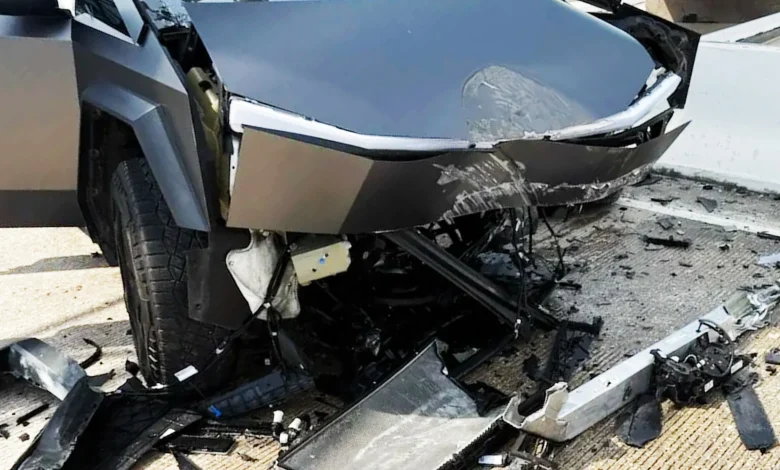
tesla is at an inflection point after Cybertruck owner Justine Saint Amour filed a lawsuit in Harris County Court alleging that Full-Self Driving (Supervised) attempted to send her vehicle straight toward a concrete barrier on an overpass, producing a crash and significant injuries.
What Is the Immediate Turning Point?
The lawsuit centers on an August incident on the 69 Eastex Freeway where Saint Amour’s Cybertruck, while running Full-Self Driving, approached a Y-shaped interchange near the 256 Eastex Park & Ride. Court filings allege the vehicle should have followed the right-hand curve but instead attempted to continue straight toward a concrete barrier. The driver intervened but could not avoid collision; dashcam footage is cited in filings and the complaint documents physical damage to the pickup.
The complaint seeks more than $1 million in damages and lists injuries including two herniated discs in the lower back, a herniated disc in the neck, sprained wrist tendons, and neuropathy. Saint Amour’s attorney, Bob Hilliard of Hilliard Law, frames the case as indictment of product design and corporate decision-making rather than an isolated equipment malfunction.
What Happens When Tesla’s Camera-Only Strategy Is Alleged To Fail?
The suit challenges the company’s decision to rely exclusively on a camera-based approach for its self-driving stack rather than integrating radar or LiDAR sensors, arguing that that design choice contributed to the crash. Court filings further assert that decisions by leadership — specifically actions attributed to Elon Musk, Tesla Inc. CEO — reflect a pattern of rejecting engineering recommendations and overpromising the system’s capabilities.
This case is positioned by its plaintiffs not only as product-liability litigation but as a test of corporate governance: filings argue that retaining the current CEO amounted to negligence when considered alongside the product decisions at issue. Parallel legal signals referenced in filings include regulatory scrutiny by the National Highway Traffic Safety Administration and prior court decisions cited in filings that sustain large judgments against the company.
What Comes Next for Plaintiffs, Regulators and the Company?
Three practical fault lines will shape the next phase, as framed in the complaint and related filings:
- Plaintiff posture: The lawsuit seeks monetary damages and presses design and marketing choices as central causes.
- Regulatory and litigation backdrop: Filings place the case against an environment of ongoing regulatory investigations and prior judgments cited in the court record.
- Corporate governance spotlight: The complaint elevates leadership decisions into the realm of negligence, testing whether courts will weigh executive retention against product-safety outcomes.
Outcomes will hinge on what the court finds about system design, the adequacy of warnings and supervision required under the marketed label Full-Self Driving (Supervised), and whether leadership-level decisions are legally attributable to the harm alleged.
What Should Readers Anticipate and Do?
Expect this case to sharpen debates over autonomy marketing, sensor architecture, and executive accountability. For vehicle owners and prospective buyers, the lawsuit highlights a need to treat supervised autonomy as an assistive feature that may require prompt human intervention. For corporate boards and regulators, the filing reframes product failures as potential governance failures when leadership choices are invoked directly in legal claims.
Whatever the legal outcome, the immediate lesson for stakeholders is to track court developments closely, review documentation tied to Full-Self Driving options, and prepare for broader implications if the complaint’s arguments about system design and leadership responsibility gain traction against tesla.