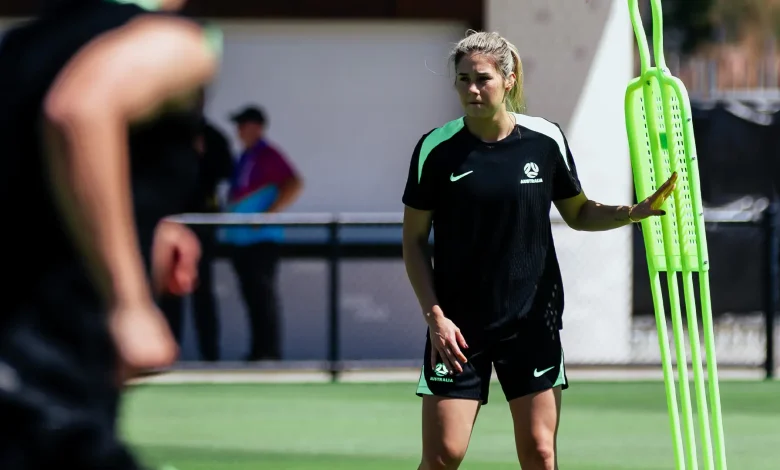
Kyra cooney cross has not featured in the Matildas’ first two matches at the Women’s Asian Cup, creating a key moment for selection, squad support and the team’s leadership both on and off the pitch.
What If Cooney Cross Returns to Fitness?
The immediate picture is straightforward: the 24-year-old midfielder did not play in the Matildas’ opening matches at the tournament. She has publicly shared the family health challenge she has faced this year, with her mother diagnosed with a rare, incurable bile duct cancer in January. Cooney-Cross returned to club action in the Champions League on February 12 but was managing illness before joining the national team camp.
Sam Kerr, the squad captain, offered a positive update on Cooney-Cross after the Iran match, saying the player “is doing good” and that she had completed a session before the team went out. Kerr added that being in camp with teammates and the available support was important for her right now. Fans and the squad will be watching whether that return to training translates into minutes in upcoming fixtures.
What Happens When Selection Is a “Headache”?
The Matildas’ midfield picture complicates any straightforward reintegration. Head coach Joe Montemurro described a pleasant problem in selection: an embarrassment of riches at the No. 6 role. Alanna Kennedy excelled in that position against Iran, and Clare Wheeler earned significant plaudits for her performance in the opener against the Philippines. Montemurro said the squad contains different midfield profiles and quality options, making selection decisions difficult.
- Cooney-Cross: 24-year-old with 63 caps for Australia, returning from illness and family matters.
- Alanna Kennedy: excelled at No. 6 in the recent match.
- Clare Wheeler: praised for performance in the opener.
Montemurro emphasised that the mix of players offers tactical flexibility: some sit deeper and distribute, others time forward runs differently. That range of qualities means Cooney-Cross will need to win back a place against strong competition, even as the coaching staff balances welfare and form.
Who Guides the Matildas on and off the Pitch?
The present squad sits within a broader lineage of players-turned-leaders who have shaped Australian women’s football. The Matildas’ only AFC Women’s Asian Cup title came in 2010 in Chengdu, a breakthrough that those involved still regard as foundational for the program. Heather Garriock, now Football Australia’s Deputy CEO, recalls the pride of that campaign after a long playing career and said the evolution since then has been striking.
Sarah Walsh, serving as COO of the AFC Women’s Asian Cup 2026 Local Organising Committee, reflected on how hard that 2010 title was to win and how the team of that era operated in a semi-professional environment. That team relied on collective sacrifice and adaptability: in the final, three first-choice forwards were unavailable and responsibility shifted to younger players, including a 16-year-old Sam Kerr, who already showed standout talent. Former coach Tom Sermanni expected players to embrace roles for the good of the team.
Those lessons — leadership from within, adaptability and institutional support — inform how current staff and executives approach player welfare and selection now. The presence of experienced figures in administrative and operational roles shapes the environment around the squad as much as on-field tactics.
Supporters are hopeful to see more of Cooney-Cross across the remainder of the tournament as she returns to full fitness and navigates competition for a starting berth; that return will test both the squad’s depth and its culture of support for players facing personal challenges like cooney cross.