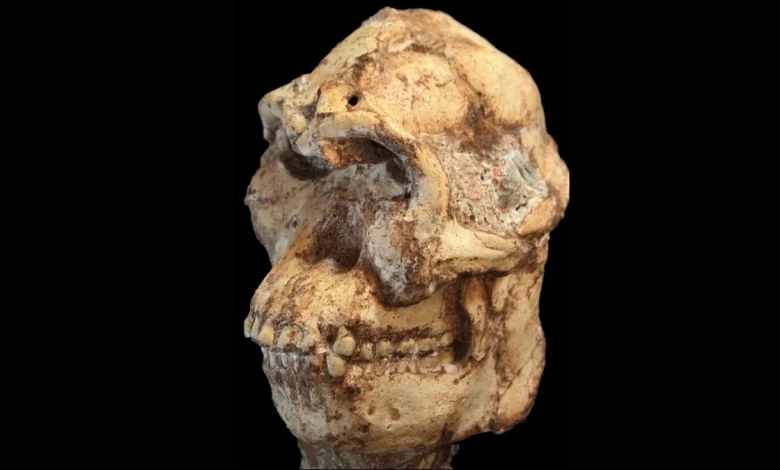
The little foot digital reconstruction of a 3. 67-million-year-old Australopithecus specimen has produced a striking portrait: a nearly complete face recreated from a crushed, rock-embedded skull that appears more similar in size and shape to East African Australopithecus specimens than to other southern African finds.
What did the Little Foot Digital Reconstruction show?
A research team led by paleoanthropologist Amélie Beaudet at the Université de Poitiers conducted high-resolution X-ray micro-CT scanning at the Diamond Light Source to produce a digital 3D recreation of the skull at a resolution of 21 micrometers. The bones and teeth were virtually separated from the surrounding matrix, and the skull was divided into five blocks that were repositioned in the digital model like pieces of a jigsaw. Landmarks were identified and measured on the reconstructed skull, and its shape was compared with multiple reference groups: other Australopithecus specimens and the skulls of modern humans, gorillas, chimpanzees, and orangutans.
The reconstructed face falls between the size of a gorilla and an orangutan, with features showing greater similarity to Australopithecus specimens from eastern Africa despite the fossil’s recovery from Sterkfontein Cave in southern Africa. At the same time, the orbital regions—its eye sockets—appear distinctly shaped compared with other specimens, a detail the researchers highlight as potentially significant for understanding visual and ecological adaptations.
Why the little foot digital reconstruction changes the picture — and what remains uncertain
The reconstruction reframes long-standing assumptions about regional distinctions among Pliocene hominins by suggesting morphological ties across geographic regions. The researchers propose that evolutionary pressure may have acted specifically on the orbital region in southern African Pliocene hominins, possibly linked to environmental instability or changing foraging demands that required particular visual capacities.
Several key uncertainties temper what the reconstruction can settle. The specimen’s skull was crushed and deformed by millions of years encased in a concrete-like rock, and some deformations could not be fully corrected. Exactly which species the specimen represents remains unresolved; the attribution to Australopithecus is common but the possibility that it represents a different or new species has not been eliminated. Sexual dimorphism within a species could produce significant morphological variation that complicates comparisons across specimens.
The researchers themselves describe the reconstruction as preliminary and note it could likely be refined in future work. The team’s methods and comparative analyses were documented in a study published in the journal Comptes Rendus Palevol. The specimen’s field history is also notable: initial discovery yielded four small ankle bones in 1980, the remainder of the skeleton emerged from the cave wall in the 1990s, and careful extraction from the tough rock required an additional 15 years of work.
Taken together, these facts point to a cautious interpretation: the little foot digital reconstruction provides a new, detailed hypothesis about facial morphology and biogeographic links among early hominins, but it does not yet close debates over species identity or the full functional significance of the skull’s distinctive orbital anatomy. Further digital refinement and additional comparative data are needed to move from a compelling visual reconstruction to definitive evolutionary conclusions.