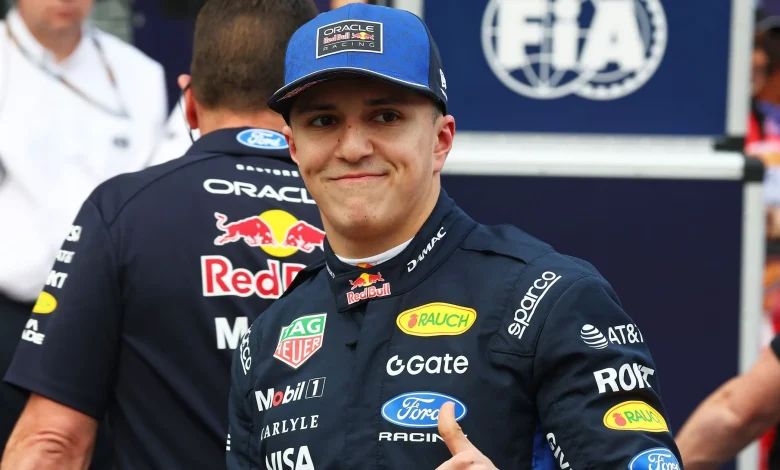
Isack hadjar arrived at the Australian Grand Prix with unexpected momentum, converting a top-three qualifying into an early race appearance that lasted only 12 laps. A mechanical problem—not conclusively identified as engine or gearbox—forced him to stop at the side of the track and prompted a Virtual Safety Car while marshals evacuated the car. The contrast between qualifying speed and an abrupt retirement framed a weekend that was at once promising and sharply unfinished.
Background: Hadjar’s Qualifying Pace and Early Retirement
Qualifying set the scene: Isack Hadjar posted the third-fastest time on Saturday, placing him behind the two Mercedes drivers, George Russell and Kimi Antonelli. That grid position signaled potential for a strong result, but in the race he completed only 12 laps before being halted by a mechanical fault. The immediate operational response included bringing the car to the trackside and implementing a Virtual Safety Car to allow for safe evacuation of the vehicle. The technical uncertainty—whether the fault was at the engine or gearbox—remained unresolved at the time of the stoppage.
Deep Analysis: Under the Surface of a Short Race
The simplest facts underline an uneasy juxtaposition: a clean qualifying performance alongside a vulnerability in race reliability. Hadjar’s ability to secure P3 showed that, at least over a single lap, the package was competitive relative to the leading Mercedes entries. Yet the race outcome highlighted the thin margin between competitive promise and operational fragility when reliability issues surface early. The Virtual Safety Car deployment, while brief, altered race management and underscored how incidents involving a single car can have immediate strategic ripple effects for rivals and team pit plans.
Complementing the on-track narrative, broader team signals from the weekend painted a picture of ambition. Red Bull management was described as having addressed internal matters, and both Max Verstappen and Hadjar were characterized as ambitious. Technical conversations from the event referenced electrical power modes—terms framed as “recharge, ” “boost, ” and “overtake”—as part of an evolving performance toolkit. Observers at the venue suggested that if Mercedes were to deploy maximum power in certain modes, the competitive balance could shift markedly.
Expert Perspectives: Voices and Immediate Reactions
Isack Hadjar (driver) provided a terse assessment after the race: “I did my job, ” a remark reflecting personal conviction amid frustration. The weekend also placed two Mercedes drivers, George Russell (Mercedes driver) and Kimi Antonelli (Mercedes driver), ahead of Hadjar in qualifying, a detail that framed the competitive hierarchy on single-lap pace. Separately, the description of Red Bull leadership and the mention of Max Verstappen (driver) alongside Hadjar indicated internal expectations of forward momentum within that operation.
Regional and Global Impact: What This Weekend Suggests
At the regional level, the Australian event offered a snapshot of shifting performance dynamics: qualifying speed for some competitors did not automatically translate into race endurance. Globally, the twin strands of outright pace and reliability are central to championship narratives; a driver who demonstrates qualifying speed but suffers mechanical attrition risks losing momentum in a tightly contested season. The technical discussion around power modes and the management of electric boost systems points to a sportwide emphasis on extracting consistent performance from complex hybrid systems, where a failure can be immediately consequential.
The interplay between management stability, driver ambition and on-track reliability emerged as a key theme. The weekend left clear markers: a driver capable of high single-lap performance, lingering technical questions after a short race, and an environment in which power deployment strategies remain decisive.
As teams assess data from the brief appearance and work to isolate the root cause of the stoppage, the central question for observers is whether the evident promise will be matched by durable race reliability. Can the pace Isack hadjar displayed in qualifying be translated into consistent race finishes, or will mechanical vulnerabilities continue to truncate his weekends?