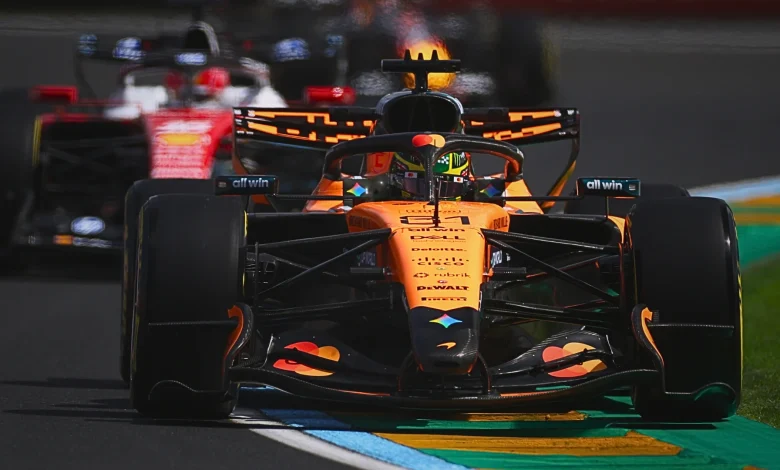
formula 1 qualifying in Melbourne produced a dramatic reshuffle: George Russell takes pole for the Australian Grand Prix, Mercedes team-mate Kimi Antonelli will start P2 after a heavy Practice Three crash, Isack Hadjar qualifies P3, Charles Leclerc P4, Oscar Piastri P5, with Max Verstappen crashing in Q1 and set to start at the back.
What Happens When Formula 1 practice pace converts to qualifying?
Mercedes showed clear speed heading into qualifying. George Russell converted that pace into pole, and earlier in final practice he posted a lap that put him substantially clear of the field. Kimi Antonelli suffered a high‑speed crash late in Practice Three at Turn 2, but Mercedes’ mechanics repaired the car in time for qualifying. A separate crash that removed a contender in Q1 produced a red flag window that aided Mercedes’ recovery efforts.
- P1 George Russell (Mercedes)
- P2 Kimi Antonelli (Mercedes)
- P3 Isack Hadjar (Red Bull)
- P4 Charles Leclerc (Ferrari)
- P5 Oscar Piastri (McLaren)
- P6 Lando Norris
- P7 Lewis Hamilton (Ferrari)
- Max Verstappen — crashed in Q1; will start at the back
What If Red Bull’s depth is tested?
Red Bull produced mixed signals across the sessions. Isack Hadjar delivered a composed qualifying, describing his final lap as “very good” after a weekend that felt difficult up to that point. Max Verstappen suffered a Q1 crash and radioed frustration about issues with his car; he will therefore begin the race from the back of the grid. The combination of Hadjar’s strong qualifying and Verstappen’s problem raises immediate questions about team recovery and whether both Red Bull cars can fight at the front if mechanical issues are resolved.
Marc Priestley, a former F1 mechanic, noted that having a second driver able to deliver on rare occasions when the lead car has problems would be a meaningful positive for a team in this position.
What If momentum, incidents and setup shape Sunday’s outcome?
The weekend so far contains three clear storylines with direct implications for the race: Mercedes’ raw pace, Antonelli’s crash and recovery, and Verstappen’s car issue that pushed him to the rear. Mercedes’ front‑row lockout positions them well, but the sequence of incidents underlines how quickly a weekend can swing — a practice crash nearly prevented Antonelli from qualifying, and a separate Q1 crash reshuffled running windows for multiple teams.
There is visible uncertainty. Some drivers who appeared fastest in practice did not convert that pace into an untroubled weekend; others recovered after limited running. Oscar Piastri, the local favourite, had disrupted running early in the weekend but topped session times later, suggesting set‑up work and track evolution remain factors between practice and qualifying order.
Three plausible short‑term outcomes emerge: a Mercedes‑led race if their pace holds, a recovery‑driven comeback from Red Bull if car issues are fixed, or a disrupted race if lingering damage or mechanical problems affect starting cars. Each path is grounded in events already unfolded on the Australian weekend.
For fans and teams alike, the immediate priorities are clear: confirm Antonelli’s readiness after the crash, diagnose and repair Verstappen’s car issues, and lock down race set‑up to translate single‑lap speed into lasting race performance. The top of the grid in Melbourne now reflects both pure pace and how teams handled late incidents in practice and qualifying — a compact snapshot of how unpredictable a formula 1 weekend can be.