The paralympics opening ceremony has become an inflection point as seven countries and the UK government announce boycotts in protest at the inclusion of Russian and Belarusian athletes under their national flags. The move has reshaped plans for the Arena di Verona event and intensified scrutiny of how global politics will intersect with sport over the coming days.
What Happens When Nations Boycott the Opening Paralympics Ceremony?
Seven national Paralympic committees — the Czech Republic, Estonia, Finland, Latvia, Lithuania, Poland and Ukraine — will not send athletes or officials to the opening ceremony in Verona, and Great Britain has said it will not send athletic representation because competitions begin imminently. The International Paralympic Committee (IPC) estimates fewer than 60% of competing countries will send a full delegation to the 2, 000‑year‑old Arena di Verona.
- Best case: The competition proceeds with the bulk of athletes participating across venues; organisers keep the focus on sport and social impact and the IPC’s operational monitoring prevents escalation.
- Most likely: Several ceremonies proceed with reduced delegations and visible political statements, while most athletes compete as scheduled; the IPC continues to defend its membership decisions and to manage logistics under strained circumstances.
- Most challenging: Wider boycotts, travel disruptions from regional conflicts, or additional delegations withdrawing from competition create schedule and participation uncertainty, forcing further contingency responses from organisers and the IPC.
These scenarios rest on facts already in evidence: the IPC has defended its decision to allow Russian athletes to compete under their own flag, citing the democratic process of its member organisations, and the body says it is closely monitoring developments and assessing impacts on the Games. The wider regional conflicts and associated travel disruptions have already created uncertainty for some delegations.
How Are Athletes and Organisers Managing War, Flags and Logistics?
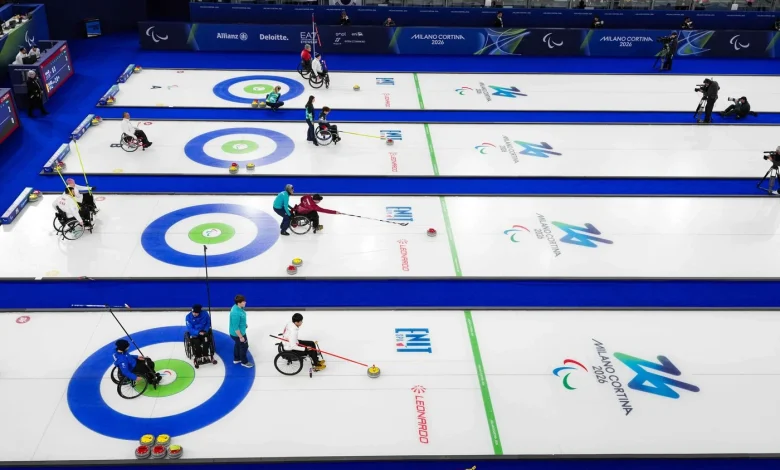
Organisers are pressing ahead with the largest Winter Paralympics on record while managing two simultaneous challenges: political protest over national symbols and the operational effects of conflict in the Middle East. About 612 athletes from 56 countries are expected to compete, making these Games bigger than recent Winter editions and marking the 50th anniversary of the Winter Paralympics. Curling competition has already begun at some venues and not all athletes will attend the opening ceremony because of training and competition schedules; volunteers will carry flags in some cases where flagbearers cannot be present.
The IPC’s president, Andrew Parsons, has defended the membership decision as the outcome of repeated votes by the organisation’s general assembly and emphasised the IPC’s role in supporting stakeholders and using the event as a platform to drive social change for persons with disability. The UK government has reiterated its opposition to Russian athletes competing under their own flag, while Stephanie Peacock, the UK minister for sport, will be in Cortina purely to support ParalympicsGB athletes rather than to attend the Verona ceremony as a government representative.
Organisers also face direct operational pressure: venue accessibility upgrades at the Arena di Verona, athlete clustering across multiple Italian sites, and the logistical reality that many competitors will be focused on immediate training and competition rather than ceremonial attendance. At the same time, the IPC has signalled it will not speculate publicly on the risk of countries being unable to compete, but it remains engaged in information-gathering and assessment.
The coming days will show whether the priority placed on competition and athlete welfare can withstand political demonstrations and external security pressures. Readers should expect a Games where sport will proceed for a majority of competitors, but where opening‑ceremony attendance and symbolic elements reflect broader geopolitical divisions. Watch for evolving participation notices and official IPC assessments as organisers work to keep events on track in the face of those pressures. paralympics