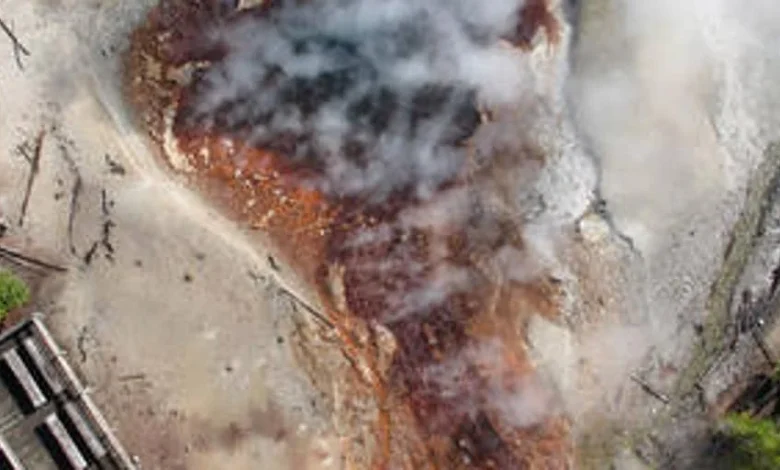
Verified fact: the echinus geyser, long dormant since 2020, produced eruptions beginning on Feb. 7 and moved into a pattern of intermittent bursts through mid-February. The scale of this reawakening — from months of silence to multiple eruptions in days — reframes the assumption that Yellowstone’s thermal features change only slowly.
What changed at Echinus Geyser and why does it matter?
Verified fact: Yellowstone National Park and the U. S. Geological Survey identify Echinus Geyser as the world’s largest acidic geyser, located in the Back Basin of Norris Geyser Basin. The feature is chemically acidic but not highly concentrated; agency statements compare its acidity to common acidic liquids rather than a corrosive solution. Historically, Echinus produced regular eruptions — in the 1970s intervals of 40–80 minutes were common, and some eruptions reached roughly 75 feet and lasted more than 90 minutes. More recently, eruptions became much less common, with only sporadic activity recorded before the 2020 dormancy.
Analysis: The contrast between decades of vigorous, predictable performance and long stretches of near silence underscores a geyser system that is sensitive to changes in underground plumbing and fluid chemistry. That sensitivity matters for public safety on boardwalks, for scientific monitoring priorities, and for how park managers present expectations to visitors.
Which agencies documented the eruptions and what do the records show?
Verified fact: The U. S. Geological Survey (USGS) and Yellowstone Volcano Observatory documented the series of events: eruptions resumed on Feb. 7, followed by intermittent bursts including on Feb. 9, 12 and 15, and a period of more frequent activity around Feb. 16 when eruptions occurred every two to five hours. Agency notes record that the recent eruptions lasted up to about three minutes with water heights reaching roughly 30 feet; earlier eras saw eruptions of greater duration and height. The USGS characterized geysers as systems that “turn on and off, ” emphasizing variability.
Verified fact: Monitoring efforts include a temperature monitoring system placed in Echinus’s outflow channel in 2010; data from that system captured 15 sporadic eruptions in the period it has operated. Michael Poland, geophysicist with the U. S. Geological Survey and Scientist-in-Charge of the Yellowstone Volcano Observatory, has contributed analysis of the basin’s dynamics in official agency communications.
Analysis: Official records show a short-lived resurgence in mid-February that then tapered; agencies note it is unknown whether the geyser will continue erupting into the summer season. The monitoring record that exists is limited but valuable; it demonstrates both the capacity to detect changes and the difficulty of forecasting persistence for a geyser prone to brief active phases.
What should the public demand now?
Verified fact: Park officials and the USGS have stated that acid concentrations at Echinus are moderate and that acidic waters can erode geyser plumbing over time, though Echinus’s acidity has not led to rapid breakdown because it is not highly concentrated. Agencies also note that geysers may become active for a month or two and then return to dormancy.
Analysis: Given the documented erratic behavior, the public interest centers on continued transparent monitoring, clear visitor guidance, and accessible disclosure of observational records. Calls for enhanced, ongoing public reporting of real-time temperature and eruption logs are grounded in the existing monitoring framework established in 2010. For researchers, the recent activity provides an opportunity to compare current chemistry, temperature and eruption rhythms with the historical record and the 15 sporadic events logged by the monitoring system.
Accountability: Officials should publish regular, labeled updates distinguishing verified fact from interpretation, maintain the monitoring equipment already in place, and clarify the limits of prediction — particularly when public access routes and viewing platforms are near an intermittently active geyser. The echinus geyser’s return is scientifically valuable but operationally unpredictable; transparency and continued data collection are the most effective responses.