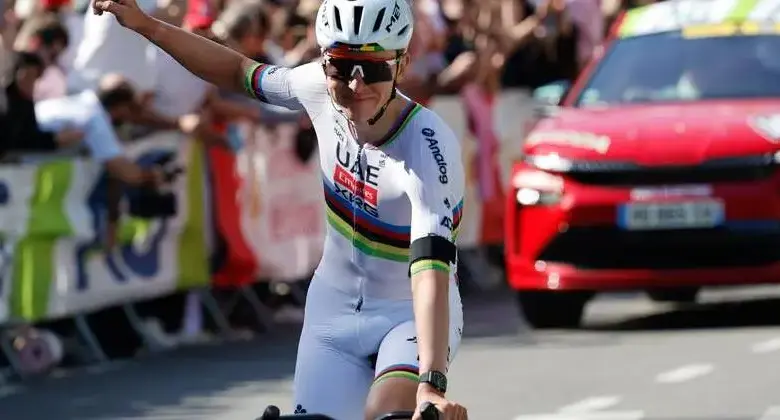
At the top level of one-day racing, dominance is often measured not just by wins, but by who can still be dropped when the pressure peaks. tadej pogačar added another sharp reminder of that reality on Sunday, pulling clear of 19-year-old French debutant Paul Seixas on the final climb to secure a third straight Liège-Bastogne-Liège title. The result was not only his fourth victory in the race, but also another sign that even a highly rated challenger can be forced into survival mode when the world champion decides to accelerate.
Pogačar’s timing, and the final climb that settled it
The decisive move came on the climb to Côte de la Roche-aux-Faucons, with less than 14km left. Seixas had already matched the rhythm set by tadej pogačar on Côte de la Redoute and stayed on his wheel for nearly 20km while others were dropped. That made the finish more revealing than routine: this was not a race won by surprise, but by a rider who waited until the road and the fatigue had done their work.
Pogačar completed the 259. 5km race in five hours, 50 minutes and 28 seconds, securing the 13th Monument title of his career and his third of the year after the Tour of Flanders and Milan-San Remo. He is now one Liège title short of Eddy Merckx’s record of five. That distance matters in historical terms, but Sunday also suggested something more immediate: tadej pogačar remains capable of turning a promising contest into a controlled conclusion.
Why Seixas mattered in this race
Seixas’ presence changed the feel of the day. The 19-year-old was trying to become the first French rider to win Liège since 1980, and for a long stretch he looked prepared to make the race uncomfortable for the defending standard-bearer. Pogačar himself singled out the teenager’s strength, saying he was “really impressed” when Seixas came back alongside him on the climb.
That reaction is important because it suggests the race was not decided by a lapse from the favorite, but by the arrival of a challenger capable of forcing a response. Seixas finished 45 seconds behind, a margin that reflects both his resistance and the final severity of the climb. In that sense, the headline was not only about another Pogačar victory. It was also about a generational test that Pogačar passed without appearing to panic.
The pressure of winning, and the scale of the achievement
Pogačar said the victory carried weight, noting that it “means a lot to win again one of the biggest races of the year” and that there is “a lot of pressure” to deliver. That matters because the narrative around elite success can flatten the effort behind repeat wins. Sunday’s result showed the opposite: the expectation to dominate does not remove the need to execute, especially in a Monument where positioning, patience and timing matter as much as raw power.
There is also the broader context of frequency. This was his third straight Liège-Bastogne-Liège title and fourth overall, placing him within striking distance of a long-standing benchmark. But the more meaningful number may be 13: the Monument count in his career, which now spans multiple classic terrains and a level of consistency that is difficult to absorb in real time.
Expert perspective and wider implications
In the race narrative itself, the clearest expert voice was Pogačar’s own. His comments offered an unusually direct assessment of the rival beside him: Seixas was not merely hanging on, but strong enough to influence the way Pogačar was mentally managing the finish. That is a telling detail because it frames the race as a duel shaped by mutual pressure rather than a solo ride from the moment of attack.
For the broader cycling picture, the implications extend beyond one Sunday result. A rider like tadej pogačar continuing to win this way raises the bar for everyone else, while Seixas’ performance hints that the next generation may already be closing in on the margins required to contest the biggest days. Remco Evenepoel’s sprint for third underlined that the race still produced separation among the best, but the central storyline remained the same: the final climb still belonged to Pogačar.
The women’s edition offered a parallel example of sustained excellence, with Demi Vollering taking her third Liège-Bastogne-Liège title after a solo breakaway 35km from the finish. That result reinforced the same competitive truth seen in the men’s race: when elite riders create separation late, the race often becomes a demonstration of control rather than chaos.
What Sunday says about the road ahead
For now, tadej pogačar remains the reference point in Liège, and perhaps in the spring classics more broadly. Yet the appearance of Seixas changes the frame around that dominance. The question is no longer whether Pogačar can win again, but who can stay close long enough to make the final climb uncertain. If Sunday was a statement of control, it was also a reminder that the next challenge may already be arriving faster than expected.