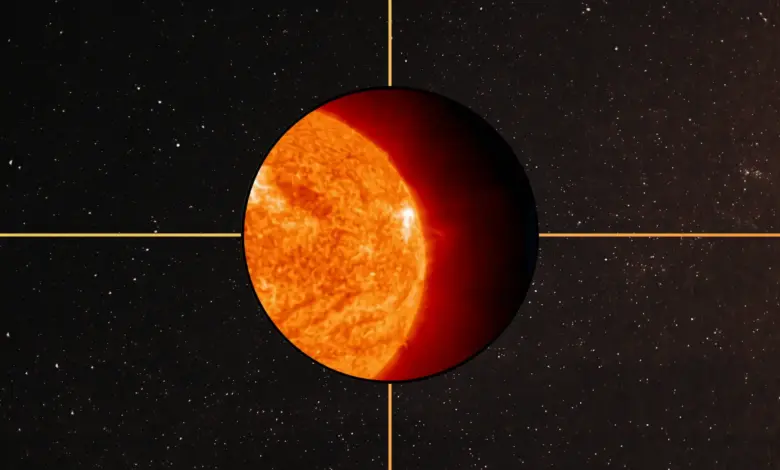
The Sun’s latest burst of activity is a reminder that space weather can turn disruptive fast. Two powerful solar flares erupted within about seven hours, and the impact was immediate on Earth’s dayside: radio signals were briefly disrupted across parts of the Pacific, Australia, and East Asia. The events were strong enough to draw attention not only because of their intensity, but because they arrived in quick succession from the same active region. In the language of space weather, solar flares are more than bright flashes; they can translate into real-world communication problems.
Why the twin eruptions matter now
The first flare peaked at 9: 07 p. m. ET on April 23, followed by a second at 4: 13 a. m. ET on April 24. NASA’s Solar Dynamics Observatory captured both events, and the first was classified as an X2. 4 flare while the second reached X2. 5. That classification matters because X-class events sit at the top of the flare scale, indicating the most intense category. In practical terms, the timing and strength of these solar flares mattered because the radiation reached the sunlit side of Earth and interfered with shortwave radio communications.
The source region, a sunspot area on the Sun’s western limb identified as AR4419, was already active before the twin eruptions. It had produced a flurry of M-class flares on April 23, and the activity included a rare sympathetic flare in two separate sunspot regions on opposite sides of the Sun. That sequence suggests a restless magnetic environment, even if the full chain of cause and effect is still being modeled.
What the radio blackouts show about space weather
The immediate effect was not a widespread technological failure, but a set of short-lived radio blackouts. The first affected parts of the Pacific Ocean and Australia; the second impacted East Asia. The mechanism is straightforward: when radiation from a solar flare reaches Earth, it ionizes the upper atmosphere, especially the ionosphere. Under stronger disturbance, the lower layers become more ionized than usual, creating conditions in which radio waves lose energy, weaken, or are absorbed entirely.
That is why the practical significance of solar flares goes beyond astronomy. High-frequency radio waves normally bounce off the ionosphere and travel long distances. When the atmosphere is more heavily ionized, that path becomes unreliable. NASA’s published material also notes that flares and solar eruptions can affect electric power grids, navigation signals, spacecraft, and astronauts. In this case, the most visible result was communication disruption, not a broader infrastructure event.
Could the Sun send more effects toward Earth?
The two eruptions appear to have been accompanied by coronal mass ejections, or CMEs, which are large expulsions of plasma and magnetic field. Because the active region is near the Sun’s western edge, it is unlikely those CMEs are aimed directly at Earth. Still, forecasters are modeling their paths, and a glancing blow remains possible. If that happens, the result could be geomagnetic storm conditions and possibly vivid aurora displays.
That uncertainty is what makes the current situation worth watching. The immediate radio impact has already been felt, but the larger question is whether the CMEs remain off-target or arrive in a weakened form. On that point, the available facts remain cautious rather than definitive, which is appropriate: not every strong flare leads to a major Earth-directed event, even when the initial burst is powerful.
Expert reading of the event
Solar physicist Ryan French described these as the strongest solar flares seen in 78 days, underscoring how unusual the pair is within the recent activity window. NASA’s scientific framing is equally clear: X-class denotes the most intense flare category, and the higher the number, the stronger the event. Together, those details help explain why the twin eruptions attracted attention even without an Earth-facing CME.
The broader scientific takeaway is not that the Sun is unpredictable, but that its active regions can produce clustered bursts with immediate communication effects. In this case, the short interval between the two X-class events, the same source region, and the geographic spread of the blackouts all point to a concentrated episode of solar activity rather than isolated flashes. That is precisely why solar flares remain a close watch item for space-weather forecasters.
Regional ripple effects and the bigger picture
For the Pacific, Australia, and East Asia, the consequences were temporary but real: disrupted radio signals on the dayside of the planet. For the wider global system, the episode is a reminder that the reach of space weather is limited by geography and timing as much as by raw strength. A flare striking the sunlit side can leave one region affected while another sees little change. The same event can also matter differently for aircraft, maritime users, and operators relying on radio-based communication.
As the active sunspot rotates out of view, attention shifts from what has already happened to what may still follow. The Sun has already shown that it can deliver back-to-back X-class bursts in a matter of hours. The open question now is whether the next consequence will stay confined to brief radio blackouts or extend into broader geomagnetic effects. For forecasters and observers alike, the next chapter in these solar flares is still being written.