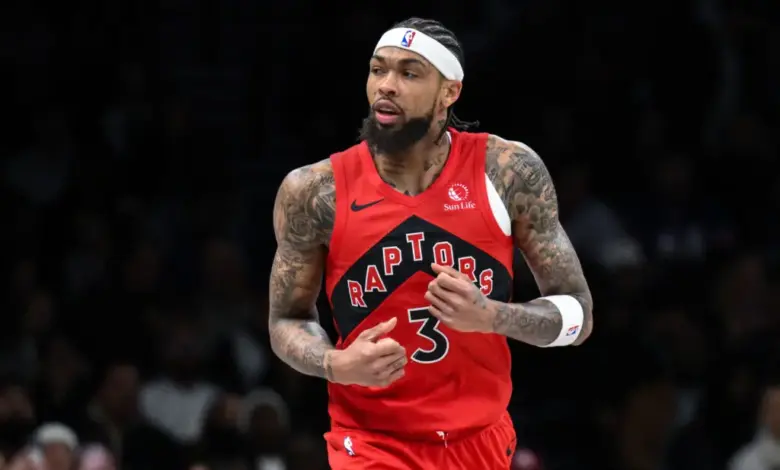
brandon ingram was supposed to steady Toronto’s first playoff push of the series, but instead his Game 1 performance became a referendum on the Raptors’ offense. In a 126-113 loss to the Cleveland Cavaliers, he took only one shot in the second half after attempting eight in the first, leaving the team’s leading scorer with more questions than rhythm. Ingram said the plan changed around him, and that shift now hangs over Toronto as the series moves into Game 2 on April 20 ET.
Why Brandon Ingram’s shot volume became the story
The numbers tell the basic story: Ingram finished with 17 points on 5-of-9 shooting, plus two rebounds, four assists, and one block in more than 36 minutes. That is not a disastrous line, but the distribution is what stood out. A player who averaged 16. 7 shot attempts per game during the regular season took just nine shots overall, and only one came after halftime. For a team already trailing 1-0, that kind of offensive disappearance is hard to ignore.
Ingram’s own explanation placed the emphasis on structure, not indecision. He said the coach wanted to use him as a screener, noting that his defender was not coming off him and that he was being used outside the action as a receiver. He added that nine shots would not be enough to win games. That is a direct critique of how the offense functioned, even if it stops short of a full confrontation.
How the game swung before the second-half freeze
The larger context matters. Toronto was not blown out from the opening tip. The first half stayed close, with the Raptors trailing by only seven points at halftime. Then Cleveland opened the third quarter with a 21-6 run in the first six minutes, a burst that effectively changed the shape of the game. Toronto did fight late, outscoring Cleveland 37-29 in the fourth quarter, but the damage had already been done.
That sequence helps explain why the discussion around brandon ingram has become so sharp. The Raptors needed a reliable offensive anchor once the margin widened, yet the ball did not flow through him in the second half. Whether that was matchup-driven, tactical, or a blend of both, the result was the same: Toronto lacked the kind of consistent scoring that can punish a strong opponent’s momentum swing.
Brandon Ingram and the Raptors’ offensive identity
This is where the debate becomes more layered. Ingram is not being asked to reinvent his game; he is being asked to fit into a playoff plan that clearly placed him in a different role once the second half began. During the regular season, he averaged 21. 5 points, 5. 6 rebounds, and 3. 7 assists, and he entered the playoffs as Toronto’s featured scorer. In his career playoff sample, he has also shown he can carry a larger load, averaging 21. 5 points, 5. 2 rebounds, and 4. 9 assists on 16. 5 shots per game across 11 games.
That background makes this game more than a single off night. If a featured scorer is reduced to a support role too early in a playoff game, the margin for error narrows quickly. The Raptors are also the road team in the series, which means they need cleaner execution and stronger scoring balance than they showed in Game 1. Without that, a comeback against an experienced opponent becomes much harder.
What Game 2 now demands
Game 2 arrives with the Raptors already facing a one-game deficit and a clear internal question: how much offensive freedom should Ingram have if Toronto wants to make the series competitive? The coaching staff may have a tactical reason for the first game’s setup, but the outcome suggests the current approach may not be enough if the offense is expected to keep pace under playoff pressure. The issue is not simply shot count; it is whether Toronto can create a plan that keeps its most productive scorer engaged without sacrificing the structure around him.
For now, the clearest takeaway is that brandon ingram’s second-half silence is not just a stat line. It is a warning sign for a Raptors team that cannot afford to let its top option drift out of the offense again. If Toronto wants to respond on April 20 ET, can it find a way to put him back at the center of the game?