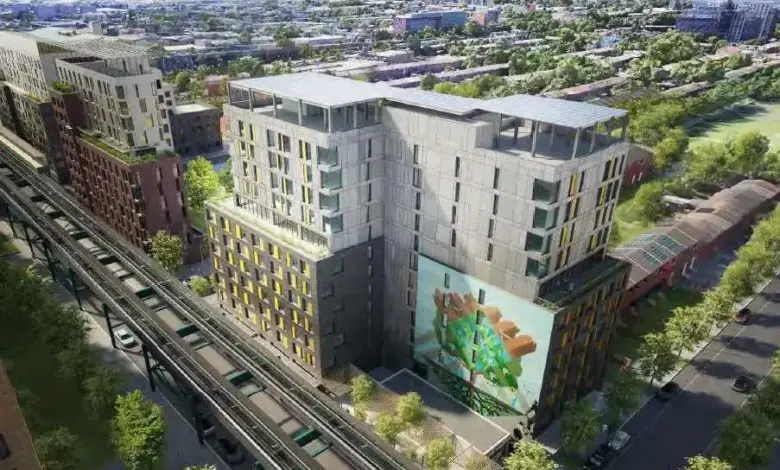
The home lottery in Brownsville has opened at a moment when senior housing demand, energy resilience, and affordability are increasingly converging in one of Brooklyn’s most closely watched neighborhoods. The new 13-story building at 350 Livonia Avenue is designed entirely for seniors, with 142 apartments in total and 47 units set aside as truly affordable.
What Happens When Affordable Housing Meets Senior Demand?
The lottery includes 47 studio and one-bedroom apartments for households of one to three people, with eligibility tied to income and age. Households must include someone 62 or older. The studios are available to one- to two-person households earning between $0 and $64, 800 a year, while the one-bedrooms are open to one- to three-person households earning between $0 and $72, 900.
Tenants will pay one-third of their income in rent, and the apartments carry an asset limit of $81, 000. Rent includes gas for heat and hot water, while electricity remains the tenant’s responsibility and covers the stove. For seniors managing fixed incomes, that mix matters: the headline rent is only part of the monthly budget.
What If the Building Becomes a Model for Resilient Senior Housing?
Gail P. Duke Senior Residence is more than a housing site. The building includes a senior center, green space, a shared laundry room, a 24-hour building super, a computer lab, elevator access, air conditioning, and bike storage lockers. It is also smoke free. The senior center will offer daily hot meals, events, fitness classes, and senior case management services through Catholic Charities Neighborhood Services.
That on-site support is important because the building is also being positioned as a resiliency resource during energy disruptions, flood-related events, or extreme heat. The architects say the property is all-electric and built to Passive House standards, with heat pump water heaters, energy recovery ventilators, a solar power system, and battery back-up for resilience. In practical terms, the project is designed for both everyday living and stress events that can strain older residents most.
What If More Projects Follow the Livonia Avenue Pattern?
The Brownsville site is part of a larger multi-site development bringing more than 420 apartments to Livonia Avenue through a partnership between Radson Development, Community Solutions, and Catholic Charities. The team was selected through a city RFP tied to the Brownsville Planning process, showing how public planning can shape private and nonprofit development toward a specific housing mix.
A neighboring 11-story, 82-unit building is already rising across Christopher Avenue at 372 Livonia Avenue. Together, the projects suggest a broader shift: denser senior housing inserted into a block of mostly two-story, single-family houses, but with services and resilience features built in from the start. That is a different model from isolated senior buildings of the past, because it combines affordability, support, and climate readiness in one footprint.
| Feature | Detail |
|---|---|
| Total apartments | 142 |
| Truly affordable units | 47 |
| Income range | $0 to $72, 900 |
| Age requirement | At least one household member age 62 or older |
| Asset limit | $81, 000 |
| Accessibility set-asides | 5% mobility disability; 2% visual or hearing disability |
There is also a targeted accessibility component: five percent of apartments are set aside for households with a mobility disability, and two percent are reserved for households with a visual or hearing disability. Those allocations underscore how the home lottery is being structured to serve seniors with different needs, not just seniors in general.
Who Wins, Who Loses?
Winners include lower-income seniors who can meet the age and income rules, especially those who value services in the building and the stability of long-term rent set to income. Residents who need support during heat events, outages, or flooding also stand to benefit from the building’s resilience design.
Losers are less direct, but the limits are real: households above the income cap, older adults without an eligible household member age 62 or older, and anyone unable to manage the asset limit will be excluded. The same is true for seniors who need housing now but do not fit the lottery structure. The broader challenge is that one project, even one built with strong design and support features, cannot solve the housing pressure facing older adults across the city.
Still, the home lottery in Brownsville shows where senior housing is heading: more specialized, more service-based, and more prepared for climate and utility disruptions than many older buildings. Readers should watch whether this approach becomes a repeatable template in other neighborhoods, because the combination of affordability, support, and resilience is likely to shape the next phase of senior housing policy. For now, home lottery