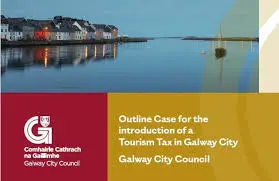
tourist tax is moving from a local idea to a live policy test in Galway, where city officials are weighing whether a small nightly charge could help fund the pressures that come with steady visitor demand.
What Happens When a City Tries to Fund Tourism Itself?
Galway City Council is seeking a three-year trial that would allow the city to apply a bed levy and assess whether it can work as a wider model. The plan is built around the idea that visitors should contribute to the costs created by tourism, rather than leaving those costs entirely to residents and ratepayers.
Helen Kilroy, Head of Finance at Galway City Council, said a back-of-the-envelope calculation suggested that a €1 charge per visitor per night could add €2 million each year to council finances. That estimate is based on 2. 4 million annual visitors and an accommodation occupancy rate of 77%.
The proposal would cover hotels and short-term lodging, with one version of the charge framed at €1. 10 to €2. 20 per visitor per night. Officials say the revenue would be ring-fenced for the tourism offering and for local infrastructure tied to the visitor economy.
What If Galway Becomes a Pilot for a Tourist Tax?
The city’s leadership wants national permission first. Any tourism levy would require legislation and approval from the Irish government, so the immediate debate is not only about whether the charge is desirable, but whether it can be authorized at all.
Chief Executive Leonard Cleary has asked councillors for a mandate to negotiate for Galway to become a pilot for a tourist tax. The council’s business case argues that tourists, as well as local communities, should contribute to the city’s socioeconomic development. It also points to services such as street cleaning, which Councillor John McDonagh said represented an investment of almost €5 million per year.
| Scenario | What it means | Policy signal |
|---|---|---|
| Best case | The levy is approved as a pilot and ring-fenced funding supports infrastructure and tourism services | Galway becomes a test case for broader local authority use |
| Most likely | The proposal advances slowly, with national approval and design details still debated | The city continues building the case before any rollout |
| Most challenging | Political resistance or perception concerns weaken the plan | The levy stalls despite support from council officials |
Who Wins, Who Loses If the Charge Moves Forward?
The strongest winners would be local services and public infrastructure if the revenue is delivered as promised. Tourism-related budgets could gain a steadier stream of support, and city officials could reduce pressure on existing finances.
Tour operators, accommodation providers, and some elected representatives may be more cautious. Sally-Ann O’Brien, Galway City Council’s new tourism officer, said Ireland is an outlier because it does not have a tourist tax, and she noted that 21 of the 27 EU member states have some form of bed tax. She also said international visitors to Galway are mostly coming from mainland Europe, the US, and the UK, and expect to pay a bed tax.
Opposition, however, is already visible. Councillor Alan Curran warned that an inconsistency in tourism numbers could severely affect the council’s ability to budget effectively. Councillor Mike Crowe said the charge is still “an additional tax and a new tax, ” and cautioned that perception could do more damage than the financial gain. Councillor Níall McNelis said the tax should also apply to short-term lets such as Airbnbs, not only hotels.
What Should Readers Watch Next?
The key issue now is whether the proposal stays a local discussion or becomes a national test of how Ireland handles visitor finance. The strongest signal will be whether the Irish government is willing to create a legal path for a pilot scheme, and whether councillors can keep the policy focused on funding rather than deterrence.
For now, the most important takeaway is simple: the case for a tourist tax in Galway is not being framed as a tourism-control measure, but as a funding mechanism for infrastructure and services. That distinction matters, because public acceptance will likely depend on whether the levy looks practical, targeted, and fair. If the proposal advances, the next phase will determine whether the tourist tax becomes a local exception or a broader model for other cities watching closely.