In the final stretch of the Roubaix Race, the crowd inside the velodrome was no longer watching a cycling contest so much as a test of nerve. Wout van Aert and Tadej Pogačar arrived there after more than five hours on the road, each carrying the weight of punctures, pressure, and a race that had punished even the strongest riders.
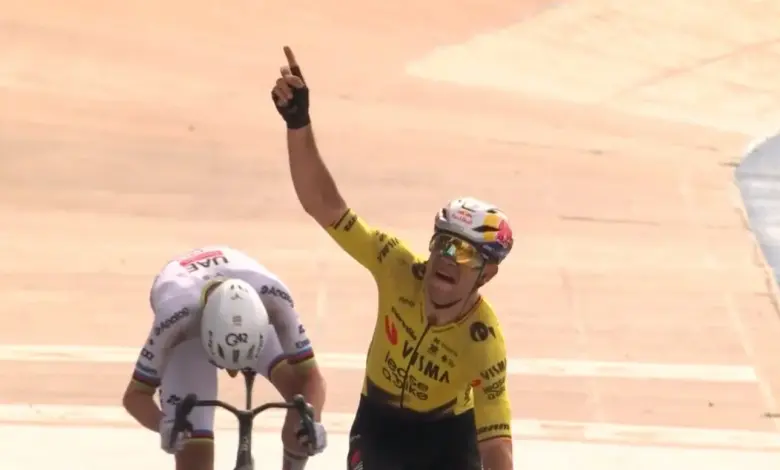
Van Aert won by a dramatic sprint to the line, taking his first Paris-Roubaix and second Monument. The finish was tight, but the meaning stretched beyond the result: this was a victory built on endurance, recovery, and the ability to keep moving when the race seemed determined to stop riders in their tracks.
How did the Roubaix Race turn into a battle of survival?
The answer lay in the cobbles. Paris-Roubaix is known for its long stretches of rough paving, and Sunday’s edition again delivered mechanical problems at the worst possible moments. Pogačar, Mathieu van der Poel, Filippo Ganna, Laurence Pithie, and others all suffered flats during crucial phases of the day. The race route included 30 cobbled sectors over 258. 3 kilometers, with the most feared sections arriving late, when fatigue and tension were already high.
Pogačar’s challenge began with a rear puncture at Quérénaing à Maing. He briefly relied on a neutral service bike before receiving a team bike and losing time. Later, van Aert suffered his own puncture at Warlaing à Brillon, showing how quickly the race could flip even for the strongest riders. The Roubaix Race was not simply fast; it was fragile.
Why did the final duel feel bigger than one victory?
Van Aert and Pogačar went toe to toe over the last 50 kilometers, and the race became a direct contest between two of the sport’s biggest names. Pogačar had arrived with a rare chance to add Roubaix to an already powerful one-day record, while van Aert was chasing a victory that had long felt within reach. In the closing phase, the two riders were so close that the outcome seemed likely to be decided in the velodrome, where van Aert opened his sprint with 200 meters to go and came around the Slovenian to seal the win.
For Pogačar, the result was another near miss in a race that had already dealt him a crash in a previous edition and a puncture this time. For van Aert, it was a reward after a difficult run of crashes and injuries in recent years. The Roubaix Race often compresses a season’s worth of hope and disappointment into a single afternoon, and this edition did exactly that.
What did the win mean for van Aert and the riders around him?
Van Aert raised a finger to the sky after crossing the line and later dedicated the victory to his former teammate Michael Goolaerts, who died after collapsing during the 2018 race. The gesture gave the finish a quieter meaning than the noise inside the velodrome suggested. It was not just a personal triumph; it was also a memory carried across the cobbles.
There were other human details threaded through the result. Guillaume Boivin, the top Canadian, had recovered from a crash to place 13th. Nickolas Zukowsky and Riley Pickrell were part of the Canadian contingent. Their presence underlined how the race is felt far beyond the front group, where each flat tire or crash can reshape an athlete’s day and, sometimes, their season.
What does this Roubaix Race say about the sport right now?
The simplest answer is that the sport still rewards resilience as much as speed. The leaders had to manage flats, repositioning, and constant pressure on narrow cobbled sectors. The race also showed how thin the line can be between control and damage. Van der Poel punctured and later dealt with cleat problems. Ganna and Pithie also lost time to flats. In that environment, success was not only about power, but about staying composed when everything around the rider was breaking apart.
The Roubaix Race ended with van Aert alone in the velodrome, but the story it told was collective: a field stretched by danger, a duel sharpened by misfortune, and a finish that turned exhaustion into meaning. As the crowd roared and the dust settled, the question lingered in the air of the old track: how much suffering can a champion absorb before the body finally says no?