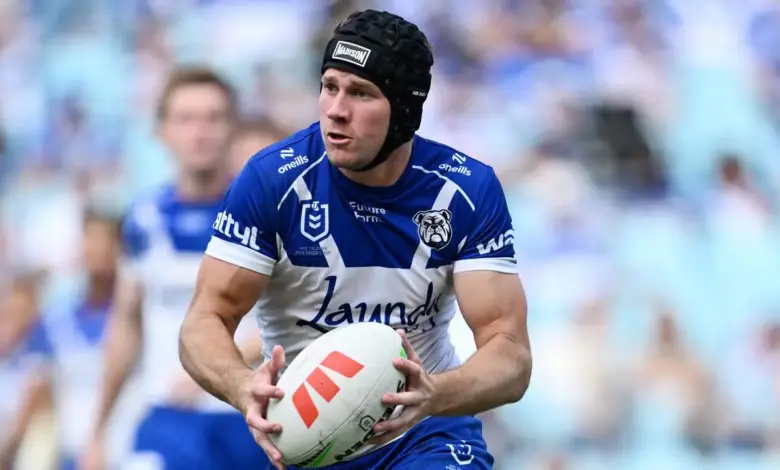
The latest Matt Burton twist inside Canterbury’s attack is not just about one player shifting positions. It has become a test of how much structural change a side can absorb before its identity starts to blur. Burton has been moved out of the halves in favour of Stephen Crichton and Sean O’Sullivan, then shifted again as the Bulldogs tried to solve a stuttering attack. The result is a growing sense that the club’s most versatile playmaker may also be its most exposed.
Why the Matt Burton question matters now
Burton’s role has been under sharper scrutiny after two consecutive weeks of being moved away from the spine. In Round 4, the change was made to lift Canterbury’s attack. Last week, the adjustment came after Crichton’s injury, with Cameron Ciraldo choosing O’Sullivan rather than Bronson Xerri as the replacement option. That pattern has placed Matt Burton at the centre of a wider selection debate, even as he remains contracted until the end of 2027.
The timing matters because the Bulldogs are already trying to steady an offence that has not consistently looked settled. The side’s recent numbers underline the strain: against South Sydney, Canterbury made 17 errors and completed at 61 per cent in a 32-24 loss. Crichton’s grade five AC joint shoulder injury adds another layer of pressure, because the Bulldogs lose a powerful outside-back presence at the same time they are still searching for rhythm.
Matt Burton and the cost of constant movement
The deeper issue is not simply where Matt Burton plays, but what repeated changes do to a team’s hierarchy. Braith Anasta’s warning was blunt: the Bulldogs risk overcomplicating the parts of the field that need the most clarity. His point was that Burton, one of the club’s best players, has been moved two weeks in a row at a moment when he had been looking dangerous with the ball.
That is where the concern extends beyond one game plan. Canterbury has already seen several pieces move in recent seasons, with Reed Mahoney and Toby Sexton among those allowed to leave under the current football leadership. The latest discussion around Burton has therefore landed in a club environment already familiar with turnover and role changes. In that setting, Matt Burton becomes more than a selection call; he becomes a marker for how stable the team truly is.
Inside the Bulldogs’ halves turbulence
The halves pairing has not settled naturally, and that uncertainty is feeding the wider debate. Burton has been asked to shift between centre and five-eighth as the club looks for the right blend alongside Sean O’Sullivan and Lachachie Galvin in the broader attacking structure. That has led to public questioning over whether the club is solving one issue while creating another.
There is also the separate matter of Burton’s future. He has been linked with a move to the Perth Bears despite his current contract, and that speculation has added noise around every positional decision. Paul Crawley argued that if a game were on the line, Burton would be among the first names chosen. David Riccio added that Burton and his management had no concerns with the positional switches or exit talk, describing the communication between player and club as open and saying Burton is the starting six at this stage. Those views matter because they show the divide between public debate and the club’s internal posture.
What experts say about the Bulldogs’ direction
Anasta’s broader concern is that Canterbury could repeat a damaging pattern from 2025, when mid-season reshuffles undermined momentum. He said Ciraldo should keep things simple and avoid moving key pieces around unnecessarily. That warning carries weight because it connects the current Matt Burton debate with a broader principle: good teams usually make roles clearer, not more confused, when pressure rises.
The Bulldogs also face a cultural balancing act. Anasta argued that Ciraldo and Phil Gould have done a strong job restoring the club’s identity, but that the team should not lose the grit traditionally associated with Belmore. That view frames the current issue as more than tactical tinkering. It is about whether the team can protect its DNA while still adapting to injuries and form slumps.
Regional consequences and the road ahead
For the Bulldogs, the immediate impact is straightforward: selection uncertainty can quickly become performance uncertainty. The return of Xerri at centre for Thursday night’s clash with Penrith suggests the club wants to close one chapter, but it also shows how fluid the picture remains. Every shuffle around Matt Burton now carries added weight because the team is trying to rebuild attacking consistency while managing injuries, speculation, and public pressure.
More broadly, the case speaks to a familiar challenge in the NRL: when a side cannot settle its spine, every adjustment can look either bold or desperate depending on the result. Canterbury still has talent, and there is no shortage of belief that the roster can win games. The question is whether the Bulldogs will let Matt Burton settle into a defined role long enough for the attack to find its shape, or whether the next correction will only deepen the uncertainty.