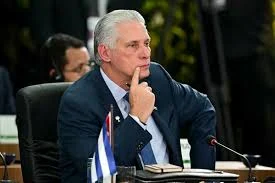
The island’s leadership has acknowledged contact with Washington at a moment of acute strain: the cuban president Miguel Díaz-Canel said talks were held to “find solutions through dialogue” while Cuba faces a three-month absence of fuel, rolling blackouts and growing public unrest. The confirmation ends weeks of speculation but raises questions about intent, leverage and what concessions — if any — might follow.
Cuban President confirms talks: Background and context
The cuban president was explicit that the exchanges were aimed at resolving “bilateral differences” between the two governments and that “international factors facilitated these exchanges. ” He linked the diplomacy to a severe energy crunch: no petroleum shipments have entered the country in the last three months, and Cuba has been compelled to rely on natural gas, solar installations and thermoelectric plants to keep essential systems running. Domestic oil production, which the government says accounts for 40 percent of national petroleum output, has been increased as part of contingency efforts, but shortfalls forced two power plants to shut and prompted a grid collapse traced to a broken boiler.
Social strain is evident on city streets and university steps: nights of pan-banging protests and a sit-in at Havana University have signaled public frustration. The government also announced that 51 prisoners will be released under an agreement with the Vatican; the timing and names to be included have not been disclosed. Prisoners Defenders places the number of prisoners of conscience in custody at 1, 214, a figure that shapes both domestic pressure and international scrutiny.
Deep analysis: Causes, implications and ripple effects
At the core of this diplomatic opening is a cascade of interlinked pressures. The cuban president emphasized the need to identify “bilateral problems that require solutions based on their severity and impact” and to test the willingness of both sides to take concrete actions for citizens’ benefit. Energy disruption is central: the depletion of fuel oil and diesel curtailed generation at solar parks and forced shutdowns that have affected communications and education. The government frames engagement as pragmatic — seeking channels to preserve the electricity grid and avert humanitarian degradation rather than signal a shift in political orientation.
Strategic signaling also emerges from personnel and posture. The public presence of Raúl Guillermo Rodríguez Castro during the president’s statement — a figure described in official commentary as influential though without a formal government post — was read as a message of internal unity. At the same time, comments from U. S. leadership that included references to a “friendly takeover” and the fate of allied leaders complicate the optics of dialogue and raise the specter of coercive leverage rather than purely negotiated accommodation.
Expert perspectives and what comes next
Carlos Alzugaray, former Cuban ambassador to the EU, framed the confirmation of talks as an intentional message: “It’s not the narrative that the US state department wants to project. That narrative is that this is a government in panic and that the US is in talks with the Castro family — that Raúl Castro is negotiating his exit and is prepared to sacrifice Díaz-Canel. That is clearly not the case. The president made a point to say the talks were directed by Raúl Castro and himself. ” His remark underscores how leadership optics and delegation are being managed within Havana.
Michael Bustamante, chair of Cuban and Cuban-American studies at the University of Miami, warned that specifics will matter: “The names will be important, ” he said, pointing to the announced release of 51 prisoners and the potential inclusion of high-profile dissidents. The selection of individuals to be freed could alter both domestic dynamics and international response, given the scale of prisoners of conscience cited by advocacy groups.
The cuban president’s confirmation also reframes humanitarian and geopolitical debates. If talks are designed principally to ease an energy blockade and stabilize the grid, outcomes could be technical and narrowly targeted. If they broaden to include security cooperation or governance demands highlighted by U. S. officials, the stakes escalate. Either path will be scrutinized for indicators of concession, resilience, or political realignment.
As the government navigates power shortages, prisoner releases and intense public discontent, the next moves — and the transparency around them — will determine whether dialogue yields limited relief or deeper shifts. Will negotiations prioritize immediate fuel deliveries and grid repairs, or will they become a forum for broader political bargaining? The answer will shape both domestic stability and regional signals about U. S. -Cuba engagement.
How will the cuban president balance urgent civic needs against long-term sovereignty concerns as these talks progress — and what metrics will observers use to judge success?